You showed up. You poured concrete in July heat, framed walls through the winter, and proved yourself season after season on American job sites. But every time your H-2B visa ran out, that same sinking feeling came back. The uncertainty. The waiting. The wondering whether this time your employer would file the paperwork again or whether you would have to pack your bags.
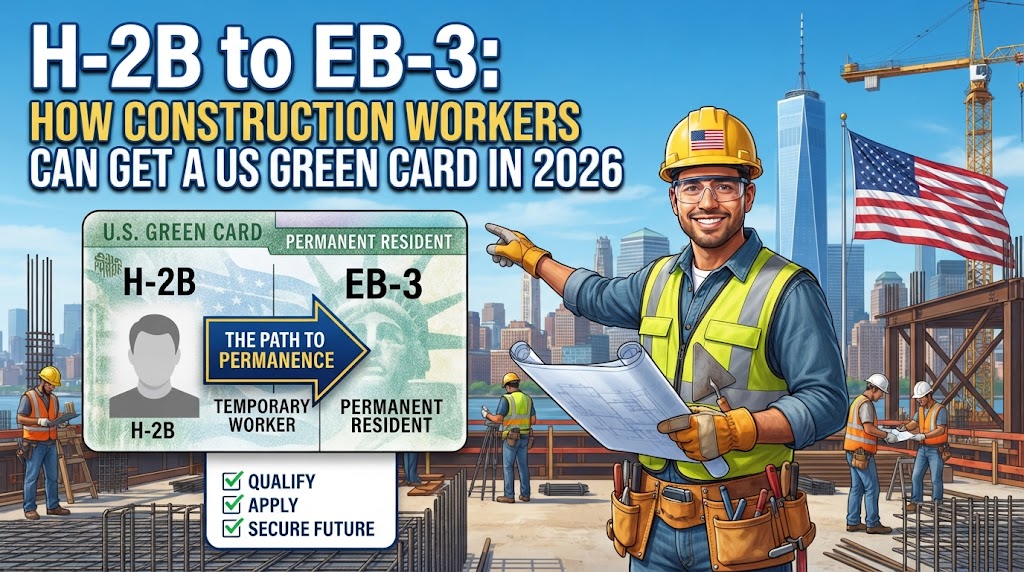
That cycle does not have to be your story anymore. Many H-2B workers are now considering the H-2B to EB-3 green card pathway as a more reliable option for long-term residency. And for construction workers specifically, the timing has never made more practical sense. Associated Builders and Contractors estimates the U.S. construction industry must attract approximately 349,000 net new workers in 2026 beyond normal hiring just to meet demand. That means construction employers across the country are desperate to keep the workers they already trust. That desperation is your leverage.
This guide breaks down exactly how the H-2B to EB-3 transition works for construction workers, what it costs, how long it takes, and what mistakes will cost you everything if you are not careful.
Why the H-2B Visa Is Not Enough Anymore
6 The H-2B visa is a temporary permission that allows workers to fill non-agricultural seasonal roles in the United States. Employers use this program when they cannot find enough U.S. workers to fill positions, and these roles often include landscaping, hospitality, construction, and seafood processing.
The problem is the word “seasonal.” The biggest challenge remains the same: the H-2B visa is temporary, unpredictable, and tied to seasonal demand. According to USCIS, the basic statutory cap for H-2B is 66,000 workers per U.S. fiscal year, divided into two halves: 33,000 for employment beginning in the first half and 33,000 for the second half. For FY 2026, the first half covers start dates from October 1, 2025 through March 31, 2026, and the second half covers April 1 through September 30, 2026. During the first three calendar days of the January 1 to 3, 2026 filing window alone, employers filed 10,062 H-2B applications requesting 162,603 worker positions for an April 1, 2026 start date. The cap fills fast. And when it fills, workers like you are left waiting.
That is why smart construction workers are using their H-2B experience as a bridge, not a destination.
What Is the EB-3 Green Card and Why Does It Matter for Construction Workers
3 The EB-3 visa is an employment-based immigrant visa that allows foreign workers to become permanent residents in the United States. Unlike the H-2B, which expires, once approved, the EB-3 visa grants you a green card, meaning you can live and work in the U.S. permanently.
According to information published directly by USCIS, you may be eligible for this immigrant visa preference category if you are a skilled worker, professional, or other worker. Skilled workers are persons capable of performing skilled labor whose job requires at least two years of training or experience, not of a temporary or seasonal nature, and who meet any educational, training, or experience requirements of the job opportunity.
For most construction workers on H-2B visas, this matters in two ways.
EB-3 Skilled Worker applies to roles like electricians, carpenters, welders, plumbers, HVAC technicians, and heavy equipment operators who can document at least two years of verified experience or training.
EB-3 Other Workers (also called unskilled workers) applies to entry-level construction laborers and support roles. Other workers are persons capable of performing unskilled labor whose job requires less than two years of training or experience, not of a temporary or seasonal nature.
Both categories require employer sponsorship. Both lead to the exact same green card. The difference is just in how much experience you bring to the table.
Who Qualifies as a Construction Worker Under EB-3
Skilled workers are in high demand in industries like manufacturing, construction, healthcare, and transportation. Construction roles that commonly qualify for EB-3 sponsorship include:
Skilled Worker Subcategory (2+ years experience required):
- Electricians and electrical technicians
- Plumbers and pipefitters
- Carpenters and framers
- HVAC technicians
- Welders and ironworkers
- Heavy equipment operators (excavators, cranes, bulldozers)
- Concrete finishers and formwork specialists
- Roofers and waterproofing specialists
Other Workers Subcategory (less than 2 years required):
- General construction laborers
- Demolition workers
- Construction site helpers
- Drywall installers
- Masonry helpers
If you have been working in construction for multiple seasons on an H-2B visa, you almost certainly qualify under the skilled worker subcategory, and that is actually the stronger filing category with better visa availability timelines.
If you want to explore general EB-3 green card pathways for construction workers, there are dedicated resources that walk through the broader process in detail.
The Real Condition That Makes This Possible
Here is something most articles skip over, and it is the most important thing to understand before you do anything else. H-2B is not EB-3. Temporary work may help build a relationship with an employer, but a green card requires a separate immigrant process.
Your H-2B experience with a construction employer is not automatically converted into a green card application. What the H-2B does is give you something priceless: a working relationship with a U.S. employer who already knows your quality, already trusts your work ethic, and is already invested in keeping you. That relationship is your starting point. The employer must be able to offer a full-time, permanent position, not seasonal and not temporary. This is the fundamental difference. Your H-2B role was filed as seasonal or temporary. Your EB-3 sponsorship requires a genuinely permanent, year-round position. H-2B can be filed on a peak-load basis, meaning the position exists year-round in the business but volume peaks during the busy season. If your laborers or groundskeepers work for you year-round and the H-2B filing reflected a peak-load need rather than a purely seasonal one, those same workers may be candidates for PERM sponsorship. The position just needs to be genuinely permanent and full-time.
This is worth a direct conversation with your employer. Many construction companies run H-2B filings for peak demand but have genuine year-round work available. That is the legal hook that makes the EB-3 process possible.
The H-2B to EB-3 Transition: Step-by-Step for Construction Workers
The EB-3 process requires three sequential steps: a PERM labor certification filed by the employer demonstrating no qualified U.S. workers are available for the permanent position at the prevailing wage, an approved Form I-140 Immigrant Petition for Alien Worker establishing the employer’s ability to pay the offered wage, and adjustment of status (Form I-485) or consular processing to obtain the actual green card.
Let me break each one down practically.
Step 1: PERM Labor Certification (Filed by Your Employer)
PERM, formally known as Program Electronic Review Management, is a Department of Labor process that requires U.S. employers to prove through a structured recruitment campaign that no minimally qualified U.S. worker is available for the position before a foreign national can be sponsored for a green card.
This is entirely your employer’s responsibility to file. The filing of applications is the responsibility of the employer, not the employee. You cannot do this yourself.
Here is what your employer must do during the PERM process:
Prevailing Wage Determination first. Employers must have a prevailing wage determination for the job opportunity issued from the Office of Foreign Labor Certification’s National Prevailing Wage Center prior to filing a PERM application. The Prevailing Wage Determination application takes approximately three months to process.
Active recruitment of U.S. workers. The PERM process requires your employer to recruit U.S. workers actively. Your company must advertise the job opening widely and document every recruitment step carefully for the labor certification application. PERM labor certification recruitment for unskilled workers requires two print ads in the major Sunday newspaper, a 30-day posting with the State Workforce Agency, and an internal PERM Notice of Filing.
Filing the ETA-9089. Your employer then files Form ETA-9089 electronically with the Department of Labor, which reviews whether your employer followed all PERM rules.
How long does PERM take in 2026? The PERM processing time in 2026 is approximately 403 days, over 13 months. Some cases move faster if they are straightforward and avoid audits. But this is the current realistic baseline you and your employer need to plan around.
Watch out for audits. The DOL audits a portion of PERM filings based on a mix of random selection and risk factors, with practitioner data pointing to roughly 25 to 35 percent of filings drawing some form of audit, supervised recruitment order, or request for information in 2026. A strong audit response usually results in certification, though it adds 6 to 12 months to processing.
One critical PERM rule construction workers miss. The date the labor certification application is received by the DOL is known as the filing date and is used by USCIS and the Department of State as the priority date. This date is important because it determines your place in the visa line. The earlier your employer files, the earlier your priority date.
Step 2: Form I-140 Immigrant Petition (Employer Files Within 180 Days)
The certification has a validity period of 180 days and expires if not submitted to USCIS within this period. Once your PERM is approved, your employer must move quickly. The employer is required to show that it has the ability to pay the wage offered and that the foreign national possesses the education, experience, and skills required in the PERM application. For construction workers, this usually means submitting proof of your work history, any trade certifications, and evidence of your previous training. The next step is filing Form I-140, Immigrant Petition for Alien Worker. Form I-140 processing time is generally 6 to 9 months.
Can you speed this up? Yes. If you choose to use premium processing, you can expedite the I-140 petition, with a processing time of 15 calendar days. The optional Premium Processing fee is $2,805. For construction employers who are serious about retaining a worker long-term, this is often worth the investment.
What happens to your family? If your I-140 petition is approved, your spouse and unmarried children under the age of 21 may be eligible to apply with or after you for admission to the United States as lawful permanent residents.
Step 3: Adjustment of Status or Consular Processing (Your Final Step)
This is where you actually receive your green card. How it happens depends on where you are when your priority date becomes current. Many workers ask if they can begin the EB-3 process while still holding H-2B status, and the answer is yes if the steps are followed correctly. This creates an opportunity to remain inside the United States during the entire process without needing to return home for consular processing.
If you are in the U.S. on valid H-2B status when your priority date becomes current, you file Form I-485 (Adjustment of Status). This keeps you in the country throughout processing.
If your H-2B has expired or you are outside the U.S. when your date becomes current, you go through consular processing, which means attending a visa interview at a U.S. embassy or consulate in your home country. Form I-485 processing time averages about 1.5 years.
How Long Does the Full H-2B to EB-3 Process Actually Take
This is where people get blindsided. Most employers are surprised by the H-2B to EB-3 green card timeline, and that surprise is what derails the process. From prevailing wage request to a worker arriving as a permanent resident, you are looking at four to five years under current conditions.
Here is a realistic 2026 timeline for most construction workers:
| Stage | Realistic Time |
|---|---|
| Prevailing Wage Determination | 2.5 to 3 months |
| Recruitment Period | Minimum 60 days |
| PERM Filing and Processing | 13 to 18 months |
| I-140 Adjudication | 6 to 9 months (or 15 days with premium processing) |
| Waiting for Priority Date | Varies by nationality (see below) |
| I-485 Adjustment of Status | Approximately 18 months |
For workers from most countries outside India, China, Mexico, and the Philippines, the total realistic timeline is 3 to 5 years from PERM filing to green card in hand.
For workers from India and China, the wait is significantly longer due to per-country caps. 12For India and China, wait times exceed 10 and 8 years respectively in the EB-3 Other Workers subcategory specifically. Indian and Chinese nationals who qualify under the EB-3 Skilled Worker subcategory may see different timelines, so it is worth discussing country-specific options with an immigration attorney.
Your priority date is everything. Each month, the State Department publishes the Visa Bulletin, a chart showing which priority dates are currently eligible for visa issuance. For the EB-3 Other Workers category for most of the world, the Final Action Date as of May 2026 is February 1, 2022. That means waiting is built into this process. Starting early is the only way to shorten your wait. That is not a reason to wait. It is a reason to start now.
The Status Timing Trap That Ends Green Card Applications
This section could save your green card process or destroy it. Read it carefully.1 If your approved H-2B period expires, you accrue unlawful presence, which triggers three- and ten-year bars if you depart the United States. USCIS does not forgive gaps. A single day of unlawful presence between H-2B petition expiration and adjustment of status filing can result in adjustment denial and removal proceedings. 1 The critical rule: file your adjustment of status application or depart the United States for consular processing before your current H-2B authorized stay expires.
The PERM process alone takes over a year before your employer can even file the I-140. 1Employer-sponsored EB-3 timelines compound this risk because the PERM labor certification process alone takes 8 to 12 months before the employer can even file the I-140 petition.
This is why immigration attorneys consistently advise that employers start the PERM process well before a construction worker’s H-2B status needs to be renewed, not after. Employers should start the PERM application process at least two years before the employee’s maximum work visa stay. However, it is a good idea to start the process earlier, as processing times can increase and unforeseen problems can arise.
Practical tip: Keep copies of every I-797 approval notice your employer has received for your H-2B petitions. Know your exact authorized stay dates. If your employer starts the EB-3 process, continue renewing your H-2B status as needed while the PERM is pending. The two processes can and should run in parallel.
Many construction workers who want to explore the H-2B visa construction jobs pathway as their entry point into long-term U.S. employment make the mistake of waiting too long before asking their employer about the EB-3 option. The conversation needs to happen early.
What This Costs: Who Pays for What
Understanding the cost breakdown matters because many construction workers fear they will have to pay for this themselves. In most cases, that is not how it works. DOL regulations expressly prohibit an employee from paying for any fees and costs associated with the PERM labor certification application process if an attorney represents both the employer and employee. Employers may generally not require employees to pay for any portion of the cost for this step.
Here is a realistic cost breakdown for 2026:
PERM Labor Certification: There is no filing fee for PERM applications. DOL processes them free of charge. However, the employer pays recruitment and advertising costs.
Form I-140: According to information from USCIS, the I-140 base filing fee is $715 plus an Asylum Program Fee of $600 for most employer petitioners, and an optional Premium Processing fee of $2,805.
Form I-485 (Adjustment of Status): $1,440 per applicant, inclusive of biometrics.
Medical examination: Applicants must account for ancillary costs such as medical examinations, typically $200 to $500.
Legal fees: Legal fees vary depending on case complexity, averaging $5,000 to $10,000 for EB-3 cases. These are typically paid by the employer, though some employers and workers negotiate cost-sharing for the I-485 stage.
Total employer investment: The process typically takes 6 to 18 months and involves legal fees and government filing costs, with the total investment often ranging from $5,000 to $10,000.
For a skilled construction worker who a company has trained and relies on, this investment is often completely worth it.
Why Construction Is One of the Best Industries for EB-3 Sponsorship Right Now
The United States is facing a critical shortage of skilled workers, particularly in the construction industry. As demand for infrastructure, residential, and commercial projects increases, the EB-3 visa category has become one of the most accessible and strategic pathways for skilled tradespeople from around the world to secure employment and permanent residency. The National Association of Home Builders reports that immigrants make up 34% of all construction workers nationwide, with that share exceeding 60% in trades such as drywall, roofing, and plastering.
Construction employers are not just open to sponsoring foreign workers. Many of them depend on it. 57% of construction firms cite insufficient supply of workers or subcontractors as a major concern for 2026.
Specific trades are especially in demand right now. Data from the Bureau of Labor Statistics shows that electricians account for roughly 81,000 annual openings with a projected growth rate of 9%, well above the average for all occupations. Carpenters account for another 74,100 annual openings with 4% projected growth. Plumbers, pipefitters, and steamfitters see about 44,000 annual openings with 4% growth. Trades such as carpentry, electrical, and plumbing are on most states’ shortage occupation lists. This shortage is exactly what makes the PERM process work in your favor. When your employer advertises the role and cannot find qualified U.S. applicants, the DOL certifies the PERM. The labor shortage in construction practically guarantees that result for most trade roles.
If you are currently exploring construction opportunities abroad while planning your move, resources like scaffolder jobs in the UK and Australia with visa sponsorship or bricklayer jobs in the UK with visa sponsorship can help you build experience and save money while your U.S. process is underway.
The Role of Your Nationality in EB-3 Wait Times
Not everyone waits the same amount of time. The EB-3 category is subject to an annual cap. Along with this cap, there is also a nationality cap in which no more than 7% of the visas in each category can go to any single nationality. This category generally has a longer wait time especially if you are Indian or Chinese. When a country has exceeded its 7% maximum annually year after year, it creates a backlog in that nationality’s priority date wait time.
For most African, Caribbean, Latin American, European, and Southeast Asian nationals: The EB-3 Skilled Worker wait is often much shorter, sometimes current or near-current, meaning you can file for your green card relatively soon after I-140 approval.
For Mexican nationals: There is a moderate backlog. For the EB-3 Other Workers category for Mexico, the Final Action Date as of May 2026 is February 1, 2022.
For Indian and Chinese nationals: Long backlogs exist in the Other Workers subcategory. Discuss EB-3 Skilled Worker category options with an immigration attorney to understand whether a different subcategory might move faster for your specific situation. Review the monthly Visa Bulletin issued by the Department of State regularly to ensure your priority date is current.
What Happens If Your H-2B Expires Before Your Green Card Is Ready
This is the scenario construction workers worry about most, and rightly so.
You have two main options depending on your situation:
Option 1: H-2B Extensions. Your employer can continue extending your H-2B status year over year while the PERM and I-140 process is pending. This is the ideal scenario because it keeps you legally present in the U.S. throughout the process.
Option 2: Consular Processing. If you are already in the United States on a valid visa like H-2B, you may be eligible to apply for Adjustment of Status, which allows you to remain in the country while your green card is processed. In some situations, especially if your status expires or you are not eligible for adjustment, you may need to complete consular processing in your home country.
Consular processing is not the end of the road. Many construction workers complete it successfully and return to the U.S. as permanent residents. The key risk is that if you have accrued unlawful presence before departing, the three- or ten-year bar may prevent your return. This is why status maintenance throughout the process is non-negotiable.
How to Actually Get Your Employer to Sponsor You
Most construction workers have the wrong approach here. They wait for their employer to bring it up. That almost never happens. USCIS data from 2025 shows that approximately 12% of H-2B visa holders successfully transitioned to lawful permanent resident status within five years of their initial entry. But 68% of those transitions happened because the worker initiated the process themselves, not because their employer volunteered the information.
You have to start the conversation. Here is how to approach it without putting your current job at risk:
Speak from the employer’s perspective, not yours. Instead of saying “I want a green card,” say “I want to stay long-term and help the company avoid rehiring and retraining costs every season. Can we talk about what it would take to make that permanent?”
Show your value first. Before raising the green card conversation, make sure your attendance record is strong, your OSHA certifications are current, and your foreman or site supervisor sees you as someone worth fighting to keep.
Understand what your employer fears. Many small and medium construction companies are intimidated by the EB-3 process. They worry about cost, complexity, and whether you might leave after they invest in you. Address those concerns directly. Offer to stay committed to a multi-year employment agreement in exchange for sponsorship.
Bring them a solution, not just a request. Come with basic information about the process. Let them know that the PERM filing itself has no government fee. Many construction employers have no idea how accessible this actually is. 2024 reforms allow smaller companies to sponsor foreign skilled workers, not just large companies. This means your general contractor or small construction firm likely qualifies as a petitioner, even if they have a smaller payroll.
Common Myths About the H-2B to EB-3 Process
Myth: You need a college degree to get an EB-3 green card. Fact: The EB-3 Skilled Worker category requires only two years of education or experience. No college degree is needed for construction trades.
Myth: Your employer automatically becomes your green card sponsor when you get an H-2B. Fact: H-2B can address temporary work authorization and authorized stay only within the approved petition. EB-3 is a separate immigrant sponsorship process. Your employer must specifically choose to file a PERM for you.
Myth: Once you have an EB-3 green card, you must stay with the same employer forever. Fact: The American Competitiveness in the Twenty-First Century Act (AC21) allows EB-3 visa holders to change employers under certain circumstances, as long as they meet specific requirements. After your green card is approved, your ability to change jobs increases significantly.
Myth: The EB-3 process is too expensive for most construction workers to pursue. Fact: Most EB-3 filing costs are paid by the employer, not the worker. DOL regulations actually prohibit employers from passing PERM costs to the employee in most circumstances.
Myth: You can apply for the EB-3 green card on your own without employer involvement. Fact: The EB-3 visa requires a job offer from a U.S. employer who must demonstrate the unavailability of qualified U.S. workers for the position. Self-petitioning is not available under EB-3.
Salary and What to Expect as a Permanent Resident Construction Worker
Once your green card is approved, your earning situation changes meaningfully. You are no longer tied to a single employer by visa status, which gives you real negotiating power. BLS occupational data for 2024 shows construction managers earn a median of $50.26 per hour ($104,530 per year). Skilled welders can command starting salaries between $45,000 and $75,000 annually. Union construction workers earned a median of $1,585 per week in 2025, compared to $1,132 for nonunion workers, a gap of approximately 40%.
While there is no fixed minimum salary requirement for the EB-3 visa, the employer must offer a wage that meets the prevailing wage for the occupation in the specific geographic area. The prevailing wage is determined by the U.S. Department of Labor. This is actually protective for you. It means your employer cannot lowball your wage just because you are a foreign worker. Location plays a crucial role in the EB-3 process. States with strong construction activity like Michigan, Ohio, and Texas often have higher demand for skilled trade workers. Similarly, areas experiencing construction booms, such as Florida and Arizona, frequently seek qualified foreign workers. Salary requirements vary by region, with urban areas typically requiring higher wages to meet prevailing wage requirements.
What Happens After You Get Your Green Card
As a green card holder, you can live and work anywhere in the United States, travel internationally, petition certain family members, and apply for U.S. citizenship after meeting eligibility requirements. The employee’s family, including spouse and children under 21, can also immigrate with the employee.
After holding your green card for five continuous years, you become eligible to apply for U.S. citizenship through naturalization, provided you meet the residency, language, and civic knowledge requirements.
Your green card also opens doors for union membership in many states, access to federal construction projects, and the ability to pursue contractor licensing in your own name. These opportunities are simply not available on a temporary H-2B visa.
Frequently Asked Questions
Can I start the EB-3 process while I am still on an H-2B visa?
Yes. Workers can start the EB-3 process while holding H-2B status, allowing them to stay in the country throughout the transition without needing to return home for consular processing.
Does my construction experience on the H-2B visa count toward EB-3 eligibility?
Yes, in most cases. Your documented construction experience from H-2B seasons can be used to satisfy the two-year experience requirement for the EB-3 Skilled Worker subcategory. Keep records of your pay stubs, reference letters from supervisors, and any trade certifications earned.
What if my employer refuses to sponsor me for EB-3?
You have limited options within that relationship. However, multiple pathways exist including employer-sponsored EB-3 visa petitions for unskilled workers, family-based immigrant petitions if you have qualifying U.S. citizen or permanent resident relatives, adjustment of status if you entered lawfully and maintain valid nonimmigrant status, or consular processing if you have departed the United States. A new employer can also choose to sponsor you. This is why building your reputation and professional network in the U.S. construction industry matters.
What if I am a construction worker in the UK or Australia looking to eventually use this pathway?
This pathway begins with getting to the U.S. first on an H-2B or other valid work visa. From there, the EB-3 sponsorship process becomes available through your employer. Some workers build their trade credentials while abroad through opportunities like bricklayer jobs in the UK with visa sponsorship before targeting a long-term U.S. position.
Can a small construction company sponsor me, or only big firms?
Under the EB-3 category, an employer can petition for a foreign person to come to the U.S. to fill an employment position if the employer was not able to find a suitable employee from the American workforce, something that can very easily be shown for most construction companies. Small and medium firms qualify as long as they can demonstrate financial ability to pay the prevailing wage.
Is there a minimum wage my employer must pay?
Your employer must pay at least the prevailing wage determined by the Department of Labor for your specific occupation and location. This wage varies by role and region and is established during the Prevailing Wage Determination stage of the PERM process.
What to Do Right Now
The construction labor shortage is real. The construction labor shortage stands as one of the most pressing strategic threats to U.S. infrastructure delivery, housing supply, and industrial expansion through at least 2027. This is not a temporary hiring challenge or a cyclical downturn effect. It is a structural gap.
That shortage is your opportunity.
Here is your action plan for the next 90 days:
Week 1 to 2: Pull together your employment records from every H-2B season. Collect pay stubs, reference letters from supervisors, and any trade certifications. Document your experience clearly.
Week 3 to 4: Have an honest conversation with your employer or HR contact about long-term employment. Frame it as a retention conversation, not a favor request. Use the labor shortage data as your context.
Month 2: If your employer is open to the idea, suggest they consult with an immigration attorney. Many attorneys offer free initial consultations, and the employer bears most of the cost from this point forward.
Month 3: Start monitoring the USCIS Visa Bulletin monthly for your country’s priority dates. Create a free account and bookmark the official USCIS website to stay updated on processing changes.
One of the most important things no one tells construction workers is this: each step of the green card process must be completed correctly, and due to long processing times, a mistake at any step may not be learned for quite some time. That is why starting early, keeping your H-2B status clean, and working with a qualified immigration attorney gives you the best possible outcome.
The American construction industry is building data centers, semiconductor fabs, highways, and homes at a scale that has not been seen in decades. It needs people who know how to work. People exactly like you.
The H-2B visa got you here. The EB-3 green card can make it permanent.
This article is for informational purposes only and does not constitute legal advice. Immigration law is complex and changes frequently. Always consult with a licensed immigration attorney for advice specific to your situation before taking any action on your visa or green card case.