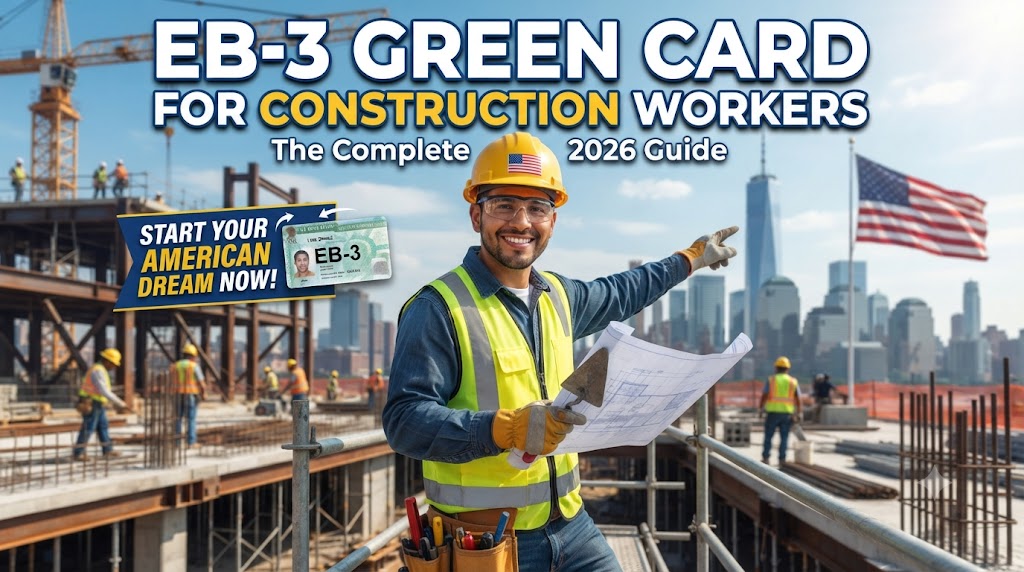
If you are a construction worker looking to build a permanent life in the United States, the EB-3 green card might be the most realistic immigration pathway available to you right now. Not because it is fast or easy. But because the U.S. construction industry is facing a serious labor shortage, and American employers are actively looking abroad to fill roles they simply cannot staff locally.
This guide breaks down everything you need to know about the EB-3 green card for construction workers in 2026. From eligibility and subcategories to the step-by-step application process, realistic timelines, costs, and the mistakes that derail applications. Whether you are a skilled carpenter, an electrician, a plumber, a heavy equipment operator, or a general laborer, there is likely a path here for you.
Let me be straightforward with you: this process takes years, not months. But for those willing to commit, it leads to lawful permanent residence and, eventually, the right to apply for U.S. citizenship. That is a life-changing outcome worth understanding deeply.
What Is the EB-3 Green Card and Why Does It Matter for Construction Workers
The EB-3 visa is a third-preference employment-based visa that allows foreign nationals to immigrate to the United States for work, leading to permanent residency (a green card). It sits below the EB-1 and EB-2 categories in priority, but it is far more accessible for workers without advanced degrees or extraordinary credentials. The EB-3 is a third-preference employment-based immigrant visa category established under the Immigration and Nationality Act. It covers three distinct subcategories, each designed for a different type of position: Skilled Workers, which are positions requiring at least two years of training or experience; Professionals, which are positions that require at minimum a U.S. baccalaureate degree or its foreign equivalent; and Other Workers, which are positions requiring less than two years of training or experience, commonly referred to as unskilled worker positions.
For construction workers specifically, you will likely fall into either the Skilled Worker or Other Worker subcategory. Understanding which one applies to you determines your timeline, your documentation requirements, and your place in the visa queue.
Why the Construction Industry Is a Strong EB-3 Candidate
This is something a lot of guides skip over, but it is worth understanding clearly. Similar to manufacturing, the construction industry faces an ongoing skilled labor shortage. Electricians and electrical specialists are among the most sought-after workers, with many regions reporting severe shortages. Plumbers and pipefitters can also find numerous opportunities, especially in rapidly growing urban areas. Heavy equipment operators and construction supervisors with proven experience are particularly valuable to employers, as these roles directly impact project timelines and safety standards. General labor roles are essential on construction sites. The Associated Builders and Contractors (ABC) estimated that the industry needed an additional 439,000 workers in 2025. That number has not meaningfully improved going into 2026. What this means practically is that construction employers have a genuine, documented need for foreign workers, which is exactly what the EB-3 PERM labor certification process is designed to capture. Construction employers face seasonal and long-term labor gaps. Sponsoring workers helps ensure project continuity. This remains relevant in 2026.
The Three EB-3 Subcategories: Which One Are You
Before anything else, you need to know which box you fall into. Getting this wrong wastes time and money.
Skilled Worker Subcategory (EB-3B)
Skilled workers are persons who are capable of performing skilled labor and whose job requires at least two years of training or experience, not of a temporary or seasonal nature. Skilled workers must also meet any educational, training, or experience requirements of the job opportunity. To qualify as a skilled labor visa candidate, you must meet the experience requirement of at least two years of job experience, training, or education relevant to the position being offered. This experience does not have to come from a single employer and can be cumulative from multiple positions.
This is the subcategory that fits most experienced tradespeople. If you are a licensed electrician with four years on the tools, a plumber with a three-year apprenticeship under your belt, a welder with documented certifications, or a carpenter who has been framing houses for a decade, the Skilled Worker subcategory is your lane.
Construction roles commonly qualifying here include:
- Electricians (journeyman level)
- Plumbers and pipefitters
- HVAC technicians
- Carpenters and framers
- Welders and structural ironworkers
- Heavy equipment operators (crane, excavator, bulldozer)
- Construction supervisors and forepersons
- Concrete finishers and masons
- Bricklayers and tile setters
The key requirement is clear: you need documented evidence of two or more years of relevant experience. Employment letters, payslips, training certificates, trade licenses, and apprenticeship completion records all count.
Other Worker Subcategory (EB-3C)
Other workers, also called unskilled workers, are persons capable of performing unskilled labor whose job requires less than two years of training or experience, not of a temporary or seasonal nature. This subcategory requires less than two years of training or experience, including jobs that do not require any education, training, or experience at all. This category applies to jobs that are non-seasonal and do not require specific qualifications beyond basic skills. Examples include roles in food services, construction, landscaping, hospitality, and more.
For construction specifically, the Other Worker subcategory covers roles like general laborers, site cleanup workers, material handlers, demolition crew members, and basic construction helpers. You do not need a trade license or years of formal apprenticeship. Examples of EB-3 jobs include construction workers carrying materials, site cleanup, and basic construction work, along with food service workers, housekeepers, manufacturing operators, and truck drivers.
Important trade-off to know: The Other Worker subcategory comes with a lower annual visa cap. 2A total of approximately 40,000 EB-3 visas can be issued each year, with only 10,000 of those for unskilled workers. This smaller quota means longer wait times compared to the Skilled Worker subcategory for applicants from most countries.
Professionals Subcategory (EB-3A)
This subcategory requires a U.S. bachelor’s degree or its foreign equivalent. It is not typically relevant for most construction workers but may apply to construction project managers, civil engineers, or site engineers who hold a related degree. We will not focus on this subcategory heavily in this guide, but if you hold a degree in civil engineering or construction management, it is worth exploring separately.
Who Can Sponsor You: The Employer’s Role
Here is something that surprises a lot of people researching the EB-3 green card. You cannot apply on your own. A U.S. employer must sponsor you. You cannot apply independently.
The employer is not just signing a form. They are committing to a multi-year process, paying significant costs upfront, and demonstrating to the U.S. government that no qualified American worker is available for the role they are offering you. For all subcategories, the U.S. employer must prove that it was unable to fill the respective position with a preferred employee, meaning a U.S. citizen or person with legal permanent resident status. It must advertise the position and, if necessary, conduct interviews with U.S. citizens or green card holders. A so-called labor certification is required. Unlike EB-2 NIW cases that can skip labor certification, all EB-3 applications require employer sponsorship and a PERM labor certification from the Department of Labor, adding 24 to 30 months before you can even file your I-140 petition.
This is not a minor detail. It shapes everything about the EB-3 process. Finding a willing sponsor is your first, most critical step, and for construction workers, it often comes down to who you know on the job site and which employers have a history of sponsoring foreign workers. For those interested in pursuing this path, the first step is typically finding an employer willing to sponsor your application. Many companies actively recruit through industry job boards and trade associations, particularly seeking workers with proven experience in their field.
States with active construction markets are your best hunting ground. Location plays a crucial role in the EB-3 process. States with strong manufacturing bases like Michigan, Ohio, and Texas often have higher demand for skilled trade workers. Similarly, areas experiencing construction booms, such as Florida and Arizona, frequently seek qualified foreign workers.
The EB-3 Application Process for Construction Workers: Step by Step
This is a multi-step process involving three different government agencies. Most people do not realize this going in, and that lack of understanding leads to unrealistic expectations and unnecessary stress. Let me walk you through each stage clearly.
Step 1: Prevailing Wage Determination
Before your employer can advertise the position or begin recruiting, they must first request a Prevailing Wage Determination (PWD) from the U.S. Department of Labor. This tells them what minimum wage they must offer and pay you. The employer must obtain a Prevailing Wage Determination from the DOL, establishing the minimum wage that must be offered and paid to the sponsored worker. This step alone currently takes between four and eight months.
For construction workers, prevailing wages vary significantly by trade and location. An electrician in New York City will have a different prevailing wage than a general laborer in rural Texas. Salary requirements vary by region, with urban areas typically requiring higher wages to meet prevailing wage requirements. Your employer must pay you at least this prevailing wage for the entire duration of your employment and through the green card process.
Step 2: PERM Labor Certification
This is the most complex and time-consuming part of the entire process. PERM stands for Program Electronic Review Management. The PERM labor certification process represents the most significant difference between EB-3 and self-petitioned categories like EB-2 NIW. Your employer must prove to the Department of Labor that no qualified U.S. workers are available for the position before you can proceed with your green card petition. Once the wage is determined, the employer conducts a structured recruitment campaign, placing job advertisements, posting the position at the worksite, and documenting the results of every application received. After recruitment closes, a mandatory waiting period applies before the employer can file Form ETA-9089, the core PERM application, with the DOL’s Office of Foreign Labor Certification.
This recruitment is not a formality. The employer must genuinely advertise the role, review every application received from U.S. workers, document why each U.S. applicant was not hired, and submit all of this as evidence to the DOL. If a qualified U.S. worker applies and is willing to take the job, the PERM cannot proceed. One of the most important EB-3 visa requirements is PERM labor certification. Before filing an immigrant petition, the employer must prove that no qualified U.S. workers are available for the position. This process is handled through the Department of Labor’s FLAG system.
Current PERM processing times in 2026: In 2026, many EB-3 PERM analyst review cases take about 503 days, which is roughly 16 and a half months, from the PERM filing date to certification after U.S. worker recruitment is complete.
If your case is audited, that timeline extends further. If the case is audited, processing can extend significantly. From first planning through PERM approval, many cases now take well over a year, often 16 months or more and sometimes longer if the case is audited or backlogs worsen.
Your priority date is established on the day your employer submits the PERM application. This date is critically important because it determines your place in the visa queue. Your priority date is the date on which your PERM application is filed. This date will follow you throughout the entire process and determines your place in line for a visa number. If there is one definition to remember from this entire process, it is this: the PERM filing date is your priority date.
Step 3: Form I-140, Immigrant Petition for Alien Workers
Once PERM is certified by the DOL, your employer files Form I-140 with U.S. Citizenship and Immigration Services (USCIS). Once labor certification is approved, the employer files Form I-140 with U.S. Citizenship and Immigration Services. This step classifies the applicant as eligible for an EB-3 visa. Once DOL certifies your PERM, your employer must file Form I-140 with USCIS. This phase involves gathering evidence of your qualifications, documenting your employer’s ability to pay, and ensuring perfect alignment between your PERM certification and I-140 petition. Completing Form I-140 with meticulous attention to consistency across all forms and evidence is critical. Even minor discrepancies between PERM certification and I-140 can trigger Requests for Evidence (RFEs).
I-140 processing time in 2026: USCIS reports that Form I-140 processing times in 2026 average approximately 11.5 months.
Premium processing option: For an additional fee of $2,965, your employer can request premium processing, which guarantees a decision within 15 business days for most Form I-140 petitions. Premium processing only speeds up the I-140 decision. Premium processing can be helpful for EB-3 I-140 cases when the employer or worker needs a quick decision on the petition. However, it does not change the priority date, does not speed up PERM, and does not reduce the Visa Bulletin wait, so it is mainly useful for faster clarity rather than a shorter total timeline.
Step 4: Waiting for Your Priority Date to Become Current
This is the stage that tests your patience the most. After I-140 approval, you wait. Applicants must wait for their priority date to become current based on the Visa Bulletin, which tracks the availability of EB-3 visas by country. After USCIS approves your Form I-140, you must wait for a visa number to become available. The Department of State publishes monthly Visa Bulletins showing current priority dates for each preference category and country of birth. Your wait time depends heavily on your country of chargeability.
This is where nationality matters enormously. India currently faces an average 12-plus year backlog, and China 4 to 6 years, depending on subcategory, while the rest of the world shows approximately 2.5 year delays for professionals and skilled workers. Visa retrogression happens when demand for green cards in a category is higher than the number of visas available, which can cause priority dates in the Visa Bulletin to move backward or stay the same for a period of time. For EB-3 Other Workers, retrogression can add months or even years to the wait after I-140 approval, but dates can also advance again in future bulletins.
Checking the monthly Visa Bulletin is something you and your employer should do every single month once your I-140 is filed. You can find the current Visa Bulletin directly on the U.S. Department of State’s official website.
Step 5: Adjustment of Status or Consular Processing
Once your priority date becomes current on the Visa Bulletin, you are ready for the final stage.
If you are already inside the United States on a valid visa, you file Form I-485, the Application to Register Permanent Residence or Adjust Status. In order to be eligible for a green card as an EB-3 immigrant while in the United States, you may file Form I-485 together, or “concurrently,” with Form I-140 if a visa is immediately available, or after the Form I-140 is approved and remains valid.
If you are outside the United States, you go through consular processing, which means attending an immigrant visa interview at a U.S. embassy or consulate in your home country. This involves attending an interview at a U.S. consulate or embassy in your home country before you can enter as a permanent resident. If your I-140 petition is approved, your spouse and unmarried children under the age of 21 may be eligible to apply with or after you for admission to the United States as lawful permanent residents based on your approval.
Realistic EB-3 Timeline for Construction Workers in 2026
People want a single number. The honest answer is more complicated. Here is the full breakdown based on current government data: The full sequence in 2026 looks like this: Stage 1, Prevailing Wage Determination, takes 4 to 8 months. Stage 2, PERM Recruitment and ETA-9089 Filing, takes 2 to 3 months for recruitment, then approximately 16 to 17 months of DOL adjudication time once the application is filed. Stage 3, I-140 Petition with USCIS, with standard processing currently running approximately six months.
After I-140 approval, add your Visa Bulletin wait time based on your country.
For most applicants outside of India and China, the complete EB-3 process typically spans 3.5 to 12-plus years from start to green card approval, with significant variation based on your country of birth and the specific EB-3 subcategory.
For construction workers from the Philippines, Nigeria, Mexico, or other high-demand countries outside of India and China, a realistic timeline for the Skilled Worker subcategory in 2026 is roughly three to five years total, assuming no audits and no retrogression. The EB-3 visa is not designed for fast results but is a structured immigration process created to balance worker demand with legal safeguards. Anyone who tells you otherwise is not being honest with you.
EB-3 Costs: What Construction Workers and Employers Actually Pay
The baseline USCIS filing fees are $2,805, broken down as $700 for Form I-140, $1,225 for Form I-485, and $880 for biometrics. PERM advertising, attorney fees, and medical exams add $2,200 to $12,000 more depending on case complexity and wait time. The EB-3 cost breaks into three distinct layers: government fees, employer-paid expenses, and applicant-borne costs.
Here is who pays what:
The employer pays: Under 20 CFR § 656.12(b), the employer must pay all costs associated with the PERM Labor Certification, including advertising, attorney, and administrative fees. It is illegal to require or accept reimbursement from the foreign worker for any portion of these expenses.
The worker typically pays: Government filing fees for I-485 and biometrics, immigration attorney fees for their personal legal representation, and medical examination fees. Medical examinations required for I-485 filing cost $200 to $500 depending on the civil surgeon and vaccinations needed, and results are valid for two years from the exam date.
Attorney fees: Flat-fee arrangements for EB-3 cases range from $3,000 to $8,000 depending on whether the attorney handles PERM and I-140 together or bills them separately.
Important warning: It is illegal to require or accept reimbursement from the foreign worker for any portion of PERM-related expenses. Violation of this rule can result in invalidation of the certification, civil penalties, or debarment from future filings. If an employer or recruiter asks you to reimburse them for PERM costs, walk away. The employers must pay all costs related to the labor certification (PERM) process. This is not negotiable under U.S. law.
What Happens to Your Green Card If You Change Jobs
This is one of the most common and most important questions construction workers ask, and most guides answer it poorly. After becoming a permanent resident, you are not permanently tied to your sponsoring employer. However, you must have originally accepted the job offer in good faith.
During the process, before your green card is approved, your situation is more complicated. If your I-485 has been pending for at least 180 days and your I-140 is already approved, you may be able to change to a similar job without starting over. This is called job portability under INA Section 204(j). Job portability allows certain employees to change jobs or employers without losing their place in the green card process. You must be the beneficiary of a pending or approved Form I-140, your Form I-485 must have been pending for 180 days or more, and the new job must be in the same or similar occupational classification.
For construction workers, “same or similar occupational classification” generally means staying in construction or a closely related trade. Jumping from construction laborer to office accountant would not qualify. Moving from carpenter to general construction foreman almost certainly would.
Construction Jobs That Commonly Qualify for EB-3 Sponsorship
Based on consistent labor market data, these are the construction and trades roles most actively sponsored under the EB-3 program:
Skilled Worker (EB-3B) roles:
- Electricians (journeyman and master level)
- Plumbers and pipefitters
- HVAC and refrigeration technicians
- Welders (certified structural and pipe welders)
- Carpenters (rough and finish)
- Heavy equipment operators (crane, excavator, grader, dozer)
- Construction supervisors and site forepersons
- Bricklayers and masonry workers
- Ironworkers and structural steel erectors
- Tile setters and flooring specialists
Other Worker (EB-3C) roles:
- General construction laborers
- Material handlers and site logistics workers
- Demolition crew workers
- Site cleanup and debris removal workers
- Concrete form laborers
- Basic framing assistants
The Skilled Worker category applies to individuals whose job requires at least two years of training or experience. Examples include electricians, mechanics, chefs, technicians, and construction workers.
Documents You Will Need to Support Your EB-3 Application
Your employer’s immigration attorney will manage most of the paperwork. But you need to gather your own documents carefully and completely. Missing or inconsistent documentation is one of the most common reasons for delays and RFEs.
Here is what construction workers typically need to provide: Organizing educational credentials with certified English translations for foreign degrees, credential evaluation showing U.S. equivalency, and documentation of any required licenses or certifications. Compiling work experience letters from previous employers documenting job duties matching PERM requirements, dates of employment, and full-time status with contact information for verification.
For construction workers specifically, you should gather:
- Employment letters from every previous employer listing your exact job title, duties, and dates
- Trade licenses or certifications (electrical license, plumbing license, welding certifications, OSHA safety cards)
- Apprenticeship completion certificates
- Educational transcripts if applicable
- Passport and any prior visa documentation
- Birth certificate with certified English translation
One thing I see people overlook regularly is the importance of consistency. Every document you submit must tell the same story. If your resume says you worked as an “electrical technician” but your employment letter says “maintenance helper,” USCIS will ask questions. Get your documentation aligned before your employer submits anything.
Common Mistakes That Derail EB-3 Applications for Construction Workers
Learning from others’ mistakes saves you years of frustration.
Mistake 1: Choosing the wrong subcategory. An employer who categorizes a skilled electrician under the Other Worker subcategory is essentially putting that worker in the back of a much longer line. Make sure the job description accurately reflects the skill and experience required.
Mistake 2: Documentation gaps in work history. Documentation errors or incomplete filings can cause significant delays. If you cannot produce employment letters from previous employers, start chasing those records now before the process begins.
Mistake 3: Not monitoring the Visa Bulletin monthly. Priority dates move forward and backward. 6If visa retrogression occurs, your application may pause until your priority date becomes current again. Monitoring the monthly Visa Bulletin helps you understand when you can proceed.
Mistake 4: Leaving your sponsoring employer before green card approval. If you leave your job before your I-485 has been pending for 180 days, you may lose your place in the process entirely. If you must change employers, consult an immigration attorney before making any moves.
Mistake 5: Trusting recruiters who promise shortcuts. No one can guarantee a faster EB-3 processing time because key steps are handled by government agencies that follow their own queues and visa limits. Good preparation and complete filings can help avoid unnecessary delays, but applicants should be cautious of any promise to “skip the line” or guarantee a specific approval date.
Mistake 6: Not understanding who pays what. Some unscrupulous employers or recruiters attempt to pass PERM costs onto workers. This is illegal. Immigration law prohibits employers from requiring employees to pay certain costs, including PERM expenses and I-140 filing fees. Employers who attempt to pass these costs to workers may face penalties and case denials.
EB-3 and the Dignity Act of 2025: What Construction Workers Should Watch
The Dignity Act of 2025 could transform the future for EB-3 workers and employers. This proposed legislation, if passed, would significantly expand worker protections and potentially revise the immigration pathway for unskilled and skilled workers. While not yet law as of July 2026, it is legislation worth tracking closely if you are in the early stages of exploring the EB-3 process.
Stay connected with official sources. The USCIS official website at uscis.gov is your most reliable, up-to-date source for EB-3 policy changes, fee updates, and processing time estimates. Bookmark it and check it regularly.
What Benefits Come With the EB-3 Green Card
People focus so much on the process that they sometimes forget why they started. Here is what you are working toward. Unlike temporary employment visas, the employment-based green card confers lawful permanent resident status. This grants the holder the right to live and work indefinitely anywhere in the United States, change employers freely, and pursue self-employment or retirement without losing immigration status. It also provides a defined pathway to U.S. citizenship through naturalisation after five years of permanent residence, provided statutory conditions are met. EB-3 visa holders can bring their spouse and children under 21 to the U.S., and they can also apply for green cards as derivative beneficiaries. The EB-3 visa leads to a green card, allowing applicants to live and work permanently in the U.S. Many EB-3 visa holders eventually advance to higher-level positions, improving their career prospects.
For a construction worker who has spent years building structures in another country, getting the opportunity to do the same work in the U.S. with full residency rights, union access, benefits eligibility, and a path to citizenship is a genuinely transformative outcome.
Myths vs. Facts About the EB-3 Green Card for Construction Workers
Myth: You need to already be in the United States to apply. Fact: Consular processing allows you to apply from your home country. Many EB-3 applicants complete the entire process from abroad and enter the U.S. as lawful permanent residents for the first time.
Myth: The EB-3 is only for unskilled workers. Fact: EB-3 visa caters to several groups, which are split into three categories: skilled workers, professionals, and unskilled workers. Experienced electricians, plumbers, welders, and heavy equipment operators all have a strong path through the Skilled Worker subcategory.
Myth: Your employer will pay for everything. Fact: Employers are legally required to cover PERM and I-140 costs. However, the worker typically covers personal legal fees, I-485 filing fees, and medical examinations.
Myth: Approval of I-140 means you have your green card. Fact: I-140 approval does not mean you receive a green card immediately. Visa availability is the next factor. The I-140 approval simply confirms your eligibility. You still need your priority date to become current and complete I-485 or consular processing.
Myth: If your employer closes down, your process is over. Fact: If your I-140 has been approved and your I-485 has been pending for 180 or more days, you may be able to transfer to a similar job with a new employer under job portability rules without losing your priority date.
FAQs: EB-3 Green Card for Construction Workers
Can I apply for an EB-3 green card without any construction experience?
Yes, under the Other Worker subcategory. Roles like general laborer, site cleanup worker, or material handler do not require two years of formal training. No formal two-year experience requirement exists for the unskilled category. However, you must still meet the employer’s minimum job qualifications and pass the labor certification process.
Can construction workers without a college degree get an EB-3 green card?
Absolutely. The Skilled Worker subcategory requires two years of experience, not a degree. The Other Worker subcategory requires no formal education at all. EB-3 generally has lower education and experience requirements compared to EB-1 or EB-2 categories.
How do I find a construction employer who will sponsor my EB-3?
Start by targeting construction companies in states with active labor shortages. Florida, Texas, Arizona, North Carolina, and Georgia are among the most active construction markets in 2026. Industry job boards, trade association networks, LinkedIn, and direct outreach to general contractors are all valid approaches. Be upfront about needing sponsorship from the first conversation.
Can I bring my family with me?
Your spouse and unmarried children under 21 can join you in the process as derivative beneficiaries. However, they do not gain lawful status in the United States until your immigrant visa or green card is approved.
What is an RFE and why does it matter?
A Request for Evidence (RFE) is a formal notice from USCIS asking for additional documentation to support your petition. RFEs are common and are not automatically a sign of trouble. However, they add months to your processing time and require prompt, thorough responses. Consistent, complete documentation from the beginning reduces your risk of receiving one.
Do I need an OSHA certification to qualify for an EB-3 as a construction worker?
OSHA certifications are not typically required as a condition of the EB-3 application itself. However, many construction employers require OSHA 10 or OSHA 30 cards as a condition of employment on U.S. job sites. If your sponsoring employer requires it, you should complete the relevant OSHA training.
Can self-employed construction workers apply for an EB-3?
No. The EB-3 pathway comes with mandatory employer sponsorship. Self-employed contractors cannot sponsor themselves under the EB-3 category.
Your Next Steps as a Construction Worker
Here is what to actually do after reading this guide:
First: Identify which EB-3 subcategory applies to your specific role. Skilled Worker if you have two or more years of documented trade experience. Other Worker if you are in entry-level construction.
Second: Start gathering your employment documentation now. Employment letters, certifications, trade licenses, and payslips. The earlier you organize this, the smoother the process will be when a sponsor is ready to begin.
Third: Research construction companies in high-demand U.S. states that have a history of sponsoring EB-3 workers. Florida, Texas, Arizona, and Georgia are your strongest starting points in 2026.
Fourth: Consult a licensed U.S. immigration attorney before committing to any agreement with an employer or recruiter. An attorney will assess your eligibility, flag any documentation gaps, and help you understand the real timeline for your specific situation.
Fifth: Bookmark the official USCIS EB-3 page and the Department of State Visa Bulletin. Check both monthly once your process begins.
Sixth: Be patient and stay informed. Working closely with your employer and staying organized greatly improves your chances of success.
The EB-3 green card for construction workers is not a quick fix. But if you are serious about building a permanent life in the United States, if you have the skills American construction companies genuinely need, and if you are willing to navigate a multi-year process with patience and discipline, this pathway is more achievable than most people realize.
The labor shortage is real. The demand for skilled tradespeople is real. Your opportunity is real. The process just requires you to be informed, organized, and persistent.
If you are looking at international construction opportunities while your U.S. process develops or as an alternative path, you may also want to explore bricklayer jobs in the UK with visa sponsorship for Nigerians or scaffolder jobs in the UK and Australia with visa sponsorship, which may offer shorter timelines for establishing yourself internationally in the construction industry.
Disclaimer: This article provides general informational content only and does not constitute legal or immigration advice. Immigration laws and policies change regularly. Always consult a qualified and licensed U.S. immigration attorney for advice specific to your individual circumstances. Verify all fees and processing times directly with USCIS and the U.S. Department of Labor, as figures are updated frequently.