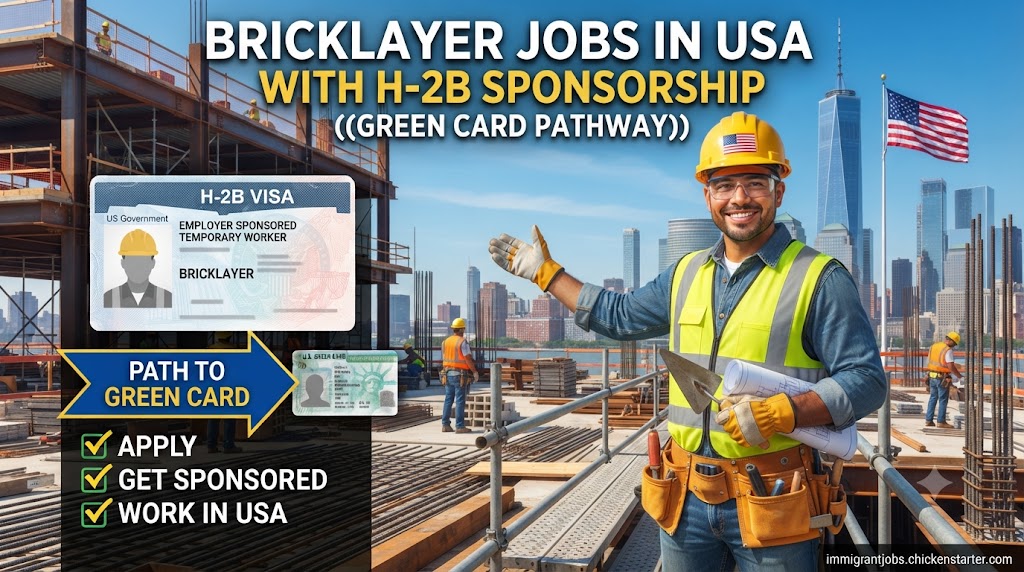
If you can lay a straight, level course of brick and you are tired of waiting for your skills to be rewarded properly at home, the United States construction industry wants to hear from you. American contractors are short of qualified masons, and that shortage has pushed wages, sponsorship offers, and hiring urgency higher than most job seekers realize. This guide breaks down exactly how bricklayer jobs in the USA with H-2B sponsorship work, what the H-2B visa can and cannot do for you, and how the road toward an EB-3 green card actually connects to it.
I have gone through immigration filings, wage data, and dozens of real job postings while researching this piece, and I will be direct with you about the parts other sites gloss over. There is a lot of hype online about “H-2B to green card in one step.” That is not accurate, and you deserve the real version.
Quick Answer: Can a Bricklayer Get a Green Card Through H-2B Sponsorship
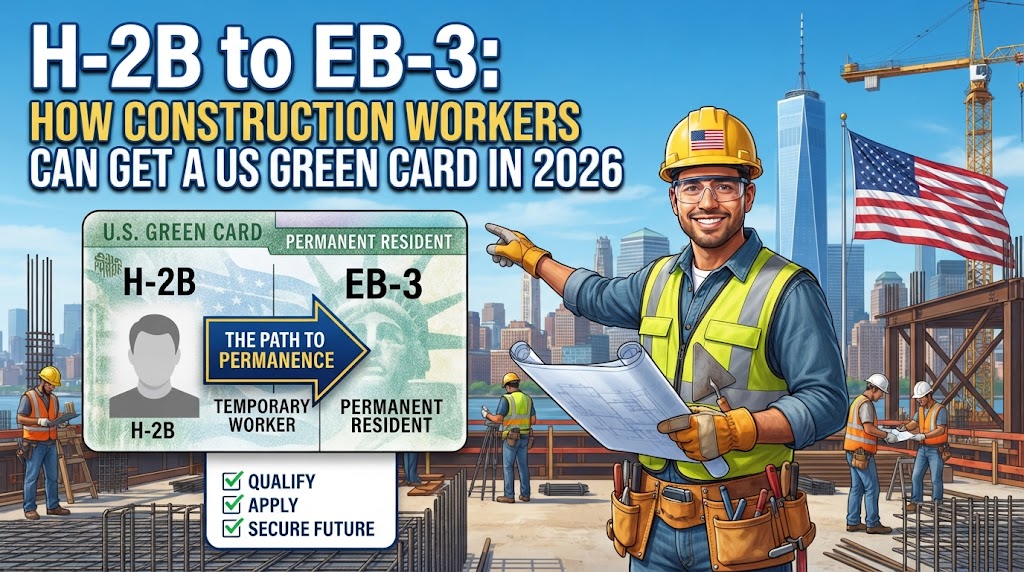
No, not directly. The H-2B visa is a temporary, non-immigrant work visa. By law it carries no dual intent, which means the government expects you to return home once your job order ends. It is not, on its own, a green card pathway.
What actually works is a two-track strategy. You take an H-2B bricklaying job to build verified US work history, a relationship with a real employer, and references that matter. Separately, and often with a different or the same employer later, you or your employer pursues an EB-3 skilled worker petition, which is the actual immigrant visa category that leads to a green card for tradespeople like bricklayers and masons. Understanding this distinction from day one will save you from wasted money and false promises. For a full breakdown of how these two programs fit together, see our guide on moving from H-2B status into an EB-3 petition as a construction worker.
What the H-2B Visa Actually Is
The H-2B program lets a US employer bring in foreign workers for temporary, non-agricultural jobs once they prove there are not enough available US workers to fill the role. According to information from US Citizenship and Immigration Services, the employer, not the worker, files the petition, and the job must fall into one of four recognized categories of temporary need: seasonal, peak load, one-time occurrence, or intermittent need.
Construction labor, including masonry and bricklaying, regularly qualifies under the peak load and one-time occurrence categories, especially for large residential developments, commercial builds, and project-based contracts that have a clear start and finish date.
How the Employer Sponsorship Process Works
Before a single visa is issued, the sponsoring company has to clear a labor certification process through the Department of Labor. That process includes:
- Filing a job order with the State Workforce Agency to test the local labor market
- Advertising the position to prove no qualified US worker wants the job
- Filing Form ETA-9142B, the Application for Temporary Employment Certification, during a defined filing window
- Filing Form I-129 with USCIS once labor certification is approved
Only after all of that clears does the case move to the US Embassy or Consulate for your visa interview. This is why legitimate bricklayer sponsorship postings rarely appear overnight. A serious employer has already invested weeks, sometimes months, of paperwork before they ever post the job publicly.
H-2B Visa Caps and Why Timing Matters So Much
The H-2B program has a statutory cap of 66,000 visas per fiscal year, split into two halves of 33,000 each. For fiscal year 2026, the Department of Homeland Security and Department of Labor jointly authorized an additional 64,716 supplemental visas, pushing the total available for the year past 130,000. Most of those supplemental slots were reserved for returning workers, meaning people who already held H-2B status in one of the prior three years.
Here is the part that surprises most first-time applicants: the cap fills within days, not months. The first-half cap for FY2026 was reached in early September of the prior year, and one of the supplemental allocations hit its limit within five business days of opening. If you are serious about a bricklayer job with H-2B sponsorship, you need to be recruitment-ready well before the filing windows open, not scrambling once you see a job ad.
How Long You Can Actually Stay
An H-2B visa is typically valid for up to one year, tied to the certified length of the employer’s need. It can be extended in one-year increments up to a maximum of three years. After three years, the law requires you to leave the US and stay outside the country for three consecutive months before you can apply again. This cycle is important to plan around, especially if your long-term goal is an EB-3 petition, because your employer relationship and documented experience during this window becomes part of your case later.
Bricklayer Job Requirements US Employers Actually Ask For
Most legitimate postings for brick mason or blocklayer roles ask for a fairly consistent set of qualifications. Based on current job listings and industry recruitment patterns, expect employers to look for:
- A minimum of two years hands-on experience laying brick, block, or stone in commercial or residential settings
- Comfort reading blueprints and construction drawings
- Physical stamina for standing, bending, and lifting materials through full shifts, often outdoors
- Basic tool proficiency, including trowels, levels, mortar mixers, and increasingly, laser levels and power tools
- A clean safety record and willingness to follow OSHA-aligned jobsite protocols
- English communication ability sufficient to follow site instructions and safety briefings
Some employers, particularly larger commercial contractors, prefer candidates with a completed apprenticeship or a recognized trade certificate, though this is not universal. Smaller residential masonry firms often weigh demonstrated skill and a strong portfolio of past work more heavily than paperwork. If you are transitioning from UK-style bricklaying experience, our guide on bricklayer jobs in the UK with visa sponsorship explains how that experience translates when you eventually target US employers.
Where to Actually Find Bricklayer Jobs With Visa Sponsorship
This is where most job seekers waste time. Generic job boards are flooded with postings that mention “visa sponsorship available” but never actually process one. Focus your energy on these channels instead:
Specialized H-2B recruitment agencies. Firms that handle H-2B filings for construction clients year-round tend to have real, active job orders because sponsorship is their core business model, not a marketing line.
Union and trade association job boards. Bricklayers and Allied Craftworkers locals sometimes maintain contact with contractors who need temporary skilled labor during peak season.
Direct outreach to masonry contractors in states with heavy construction activity, particularly Texas, Florida, North Carolina, and parts of the Midwest, where residential and commercial building has stayed strong.
Government-adjacent labor certification records. Once an employer files ETA-9142B, that filing becomes part of the public labor certification data. Serious applicants sometimes track newly certified construction labor orders to identify companies actively sponsoring.
Red Flags That Mean You Should Walk Away
Be alert for postings or recruiters that charge you an upfront “processing fee” before any job offer exists, promise a green card “guaranteed” through H-2B alone, ask you to pay for your own labor certification costs, which by law belong to the employer, or refuse to name the actual sponsoring company. Legitimate H-2B sponsorship never requires the worker to pay recruitment or placement fees, and reputable employers are transparent about who they are.
Bricklayer Salary in the USA: What the Data Actually Shows
According to information from the US Bureau of Labor Statistics, the median annual wage for masonry workers as a broad occupational group was $56,600, with the lowest ten percent earning under $38,520 and the highest ten percent earning above $90,120. Brickmasons and blockmasons specifically trend higher within that range, with recent industry wage compilations placing the national median closer to $62,000 annually, reflecting continued year-over-year growth driven by construction labor shortages.
Pay varies significantly by region. Coastal and high-cost metro markets, especially in California and parts of the Northeast, pay well above the national median. Nonmetropolitan areas and the Midwest tend to sit closer to or slightly below it. If you are comparing offers, always ask for the hourly prevailing wage rate listed on the employer’s labor certification filing. That figure is legally binding and gives you a far more reliable number than a vague salary range in a job ad.
Keep in mind that H-2B wages must legally match the prevailing wage for that occupation in that specific location, as determined by the Department of Labor. Employers cannot legally pay you below that rate, and this protection exists specifically so H-2B labor cannot be used to undercut local wages.
Step by Step: From Application to Working Bricklaying Job in the USA
Here is the realistic sequence, stripped of the exaggerated promises you will see on some recruitment pages.
Step one. Build a strong, evidence-backed portfolio of your masonry work, including photos, references, and any trade certificates. Employers weigh demonstrated skill heavily.
Step two. Identify and apply to genuine H-2B sponsoring employers or licensed recruitment agencies that specialize in construction labor placement.
Step three. Once an employer commits, they handle the labor certification and I-129 filing. Your job during this stage is to respond quickly to document requests and stay reachable.
Step four. After USCIS approves the petition, you apply for your H-2B visa at a US Embassy or Consulate, providing your job offer, passport, and evidence of ties to your home country to satisfy the non-immigrant intent requirement.
Step five. Once your visa is issued, you travel to the US and begin work under the terms certified in the labor order, including the agreed wage and job duties.
Step six, and this is the step most guides skip, start planning your EB-3 strategy while you are still employed, not after your H-2B term is close to expiring. If you want to explore the parallel route for another masonry-adjacent trade, our piece on scaffolder jobs in the UK and Australia with visa sponsorship shows how similar sponsorship logic applies across different trades and countries.
The EB-3 Skilled Worker Route for Bricklayers, Explained Properly
This is the section that matters most if a green card is your real goal. The EB-3 visa has three subcategories: professionals, skilled workers, and other workers, sometimes called unskilled workers. Bricklaying, because it typically requires at least two years of training or hands-on experience through an apprenticeship or equivalent, usually fits the EB-3 skilled worker subcategory rather than the “other worker” category used for entry-level roles like housekeeping or food service.
This distinction matters enormously. Skilled worker petitions are not subject to the same severe backlog that the “other worker” category faces, where wait times have historically stretched for years due to a much smaller annual allocation of roughly 10,000 visas shared across that entire subcategory worldwide.
How the EB-3 Process Works
Labor certification, known as PERM, comes first. Your employer files with the Department of Labor, proving again, separately from any H-2B filing, that no qualified US worker is available and that they will pay at least the prevailing wage for the role.
Form I-140 follows once PERM is certified. This is the actual immigrant petition, filed by the employer, that classifies you under EB-3.
Priority date and the Visa Bulletin. Your place in line is determined by your priority date, the date your PERM application was filed. You then track the monthly Visa Bulletin published by the Department of State to see when your date becomes “current.”
Consular processing or adjustment of status. Once your priority date is current, you either attend an immigrant visa interview abroad or, if you are already lawfully present in the US, file to adjust status without leaving the country.
Processing timelines vary widely depending on your country of origin and current backlog levels, but skilled worker EB-3 cases commonly run in the range of two to four years from PERM filing to green card issuance, sometimes faster, sometimes slower depending on Visa Bulletin movement. For a deeper look at how this plays out specifically for tradespeople, read our dedicated breakdown of the EB-3 green card process for construction workers.
Why H-2B Experience Genuinely Helps Your EB-3 Case
Even though the two programs are legally separate, H-2B experience is not wasted time. It gives you documented, verifiable US employment history, a US-based professional reference, familiarity with US jobsite standards and safety codes, and, often, a direct relationship with an employer who may later be willing to sponsor your EB-3 petition once they have seen your reliability firsthand. Contractors are far more willing to invest in a multi-year immigrant petition for someone whose work they have already tested through a temporary H-2B term.
If you want to compare how other entry points into US construction sponsorship work, our guide to H-2B visa construction jobs covers roles beyond bricklaying that follow a similar logic.
Certifications and Training That Strengthen Your Application
While a high school education and on-the-job training remain the baseline entry point into masonry, a few credentials noticeably improve your standing with US employers:
- OSHA 10 or OSHA 30 safety certification, which signals you already understand US jobsite safety expectations
- Completion of a recognized apprenticeship program, ideally three to four years, which strengthens your case for the skilled worker classification under EB-3
- Documented specialty skills, such as decorative brickwork, restoration masonry, or structural block work, which set you apart from general laborers
- A basic English proficiency record, increasingly relevant given recent Department of State screening updates tied to English language verification for certain visa categories
Myths vs Facts About Bricklayer Visa Sponsorship
Myth: H-2B automatically leads to a green card. Fact: it does not. H-2B is strictly temporary and has no dual intent. The green card comes through a separate EB-3 filing.
Myth: You need a university degree to qualify for EB-3. Fact: the skilled worker and other worker subcategories exist specifically for trades and roles that do not require a degree, only relevant training or experience.
Myth: Any recruiter promising sponsorship is legitimate. Fact: legitimate sponsorship never requires you to pay recruitment or placement fees, and the employer, not you, covers PERM and labor certification costs.
Myth: Bricklaying pays poorly compared to other trades. Fact: current wage data places brickmasons and blockmasons among the higher-paid construction trades, above carpenters and heavy equipment operators nationally.
Common Mistakes Job Seekers Make
The most frequent mistake I see is applicants waiting until an H-2B term is almost over before even researching the EB-3 process, which forces a rushed and weaker application. A close second is paying upfront fees to recruiters who cannot name a real sponsoring employer or show an actual job order. Third is underestimating how competitive and time-sensitive the H-2B cap window is, then missing the filing period entirely for that fiscal year. Finally, many candidates undersell their actual experience level on applications, which can push them into a lower classification than their real skill level supports, particularly relevant for the EB-3 skilled versus other worker distinction.
An Honest Industry Observation
Having researched dozens of active labor certification filings and current job postings for this piece, one pattern stands out clearly. Employers sponsoring bricklayers right now are not doing it as a favor. They are doing it because qualified masons are genuinely hard to find in the current US labor market, and that scarcity is exactly why wages for this trade have climbed faster than several other construction occupations over the past year. That gives you real negotiating leverage, but only if you approach the process with verified documentation and patience rather than chasing the fastest-sounding offer online.
Regional Demand and Seasonal Hiring Patterns Worth Knowing
Bricklaying demand in the US is not evenly spread, and timing your application around regional building cycles noticeably improves your odds. Texas and Florida run construction activity nearly year-round because of population growth and mild winters, making them consistent sources of H-2B masonry job orders. North Carolina, South Carolina, and Georgia have seen sustained residential development, particularly in fast-growing suburban corridors, which keeps demand for brick and block work steady.
Northern states follow a more seasonal pattern. Masonry work in the Midwest and Northeast typically ramps up in spring, peaks through summer, and slows sharply once winter weather sets in, since exterior brickwork is difficult and often unsafe in freezing conditions. If an employer in these regions is filing an H-2B order, it will usually be timed for a spring start date, which lines up with the earlier half of the fiscal year cap window. Knowing this lets you time your outreach to recruiters and employers several months ahead, rather than applying reactively once a posting appears.
Commercial construction, including data centers, warehouses, and institutional buildings, has also been a growing source of masonry demand recently, particularly in states seeing heavy industrial investment. These larger projects sometimes offer longer contract terms than typical residential jobs, which can translate into a more stable H-2B term and a stronger foundation for a future EB-3 case, since longer, well-documented employment history strengthens your overall petition.
What It Actually Costs to Pursue This Route
Money questions get skipped in most guides, so let’s be specific. On the employer side, PERM and labor certification filing fees, H-2B petition fees, and Fraud Prevention and Detection fees are legally the employer’s responsibility. As of 2026, H-2B filing costs for employers start around $460 plus a $150 Fraud Prevention and Detection fee, scaling with business size and number of workers requested. If a recruiter or agency asks you, the worker, to cover any part of that, treat it as a serious red flag.
On your side, expect to personally cover your passport costs, the consular visa application fee, any required medical examination, and, once you are actually filing an EB-3 case later, immigration attorney fees and USCIS filing fees tied to Form I-140 and adjustment of status or consular processing. Employers typically pay all PERM-related costs by law, but attorney fees tied to your personal petition, if you choose to use your own counsel rather than relying solely on the employer’s attorney, are usually your responsibility. Budget conservatively and ask any employer or agency for an itemized breakdown before committing to anything.
Comparing the US H-2B and EB-3 Route to UK, Canada, and Australia Options
Nigerian and other international bricklayers often ask which country offers the fastest realistic path to stable, long-term status. Here is an honest comparison based on how each system is actually structured, not marketing claims.
The United Kingdom route typically runs through a Skilled Worker visa tied to a licensed sponsor, and it can lead to settlement after five continuous years, generally faster and more predictable than the US EB-3 backlog for many nationalities. Our guide on bricklayer jobs in the UK with visa sponsorship walks through that process in detail.
Canada offers multiple provincial nominee streams specifically targeting skilled trades, often with a more direct permanent residency timeline than the US system, though demand and provincial quotas shift frequently.
Australia runs its own skilled trades sponsorship programs, and masonry-related trades regularly appear on regional shortage occupation lists, which can meaningfully shorten wait times compared to standard skilled visa categories.
The United States, by contrast, generally offers the strongest wages among these four options for masonry specifically, but the EB-3 path can take longer overall once you factor in Visa Bulletin backlogs for certain countries. The right choice usually comes down to how much you value speed to permanent status versus earning potential during the interim years. Many experienced tradespeople actually pursue more than one country’s sponsorship route in parallel rather than betting everything on a single pathway.
What to Expect on a US Masonry Job Site
Understanding the day-to-day reality helps you prepare mentally and practically before you commit to relocating. Most H-2B masonry crews work full eight to ten hour shifts, often starting early to avoid peak heat in southern states like Texas and Florida. Crews are typically organized under a lead mason or foreman, and you will be expected to work efficiently within an established crew rhythm rather than at your own independent pace, which can feel different from smaller-scale work back home.
Safety culture is stricter than in many other countries. Expect daily toolbox talks, mandatory hard hats and high-visibility vests on active sites, and documented safety briefings before any work involving scaffolding or elevated platforms. Employers take OSHA compliance seriously because violations carry real financial penalties, so following instructions precisely, even when they seem overly cautious, protects both you and your employer.
Housing arrangements vary. Some H-2B construction employers provide or help arrange worker housing near the jobsite, particularly for larger residential development projects, while others expect workers to arrange their own accommodation. Always clarify this in writing before you travel, since it significantly affects your real take-home budget.
Interview and Application Tips That Actually Move the Needle
When a US employer or recruiter reviews your application, a few things consistently separate strong candidates from the rest. Bring visual proof of your work. Photos of completed brick and block projects, ideally with some variety showing different bonding patterns, corners, and finishes, carry more weight than a written resume alone in a trade like this.
Be specific about your experience, not vague. Saying “I have laid brick for six years on residential and light commercial projects, including load-bearing walls and decorative facades” tells an employer far more than “experienced bricklayer.”
Know your tools and terminology in American English. Some terms differ slightly from UK or other English-speaking countries. Familiarize yourself with US-standard measurements, since American construction still commonly uses imperial units rather than metric.
Ask direct questions about the sponsorship process during the interview. A legitimate employer will not be offended by questions like “will you be filing the labor certification and I-129 on my behalf” or “what is the expected wage rate on the certified labor order.” Their willingness to answer clearly is itself a strong signal of legitimacy.
Frequently Asked Questions
Can I apply for an H-2B visa myself without an employer?
No. H-2B is entirely employer-driven. You cannot self-petition. A US employer must file on your behalf after completing labor certification.
How long does the whole H-2B to EB-3 journey typically take?
There is no fixed timeline, but a realistic estimate combines one to three years of H-2B work experience with an additional two to four years for a full EB-3 petition, depending on your priority date and Visa Bulletin movement.
Do I need to be in the US to start an EB-3 petition?
No. EB-3 petitions can be filed by a US employer on behalf of a worker who is still abroad, followed by consular processing once the priority date is current.
Is bricklaying considered a skilled or unskilled trade under EB-3?
Generally skilled, since it typically requires at least two years of training or apprenticeship experience, which meets the EB-3 skilled worker threshold rather than the more backlogged “other worker” category.
What states have the most bricklayer sponsorship opportunities right now?
Based on current job order activity, Texas, Florida, North Carolina, and several Midwest states show consistent demand due to sustained residential and commercial construction volume.
Final Thoughts and Your Next Step
Bricklayer jobs in the USA with H-2B sponsorship are real, and the wages currently reward the trade well, but the path to a green card runs through EB-3, not H-2B itself. Treat the H-2B term as your proving ground, document everything, build a genuine relationship with a real employer, and start your EB-3 research long before your temporary status runs out. That sequencing, more than any single application, is what separates job seekers who eventually get their green card from those who stay stuck cycling through temporary visas year after year.