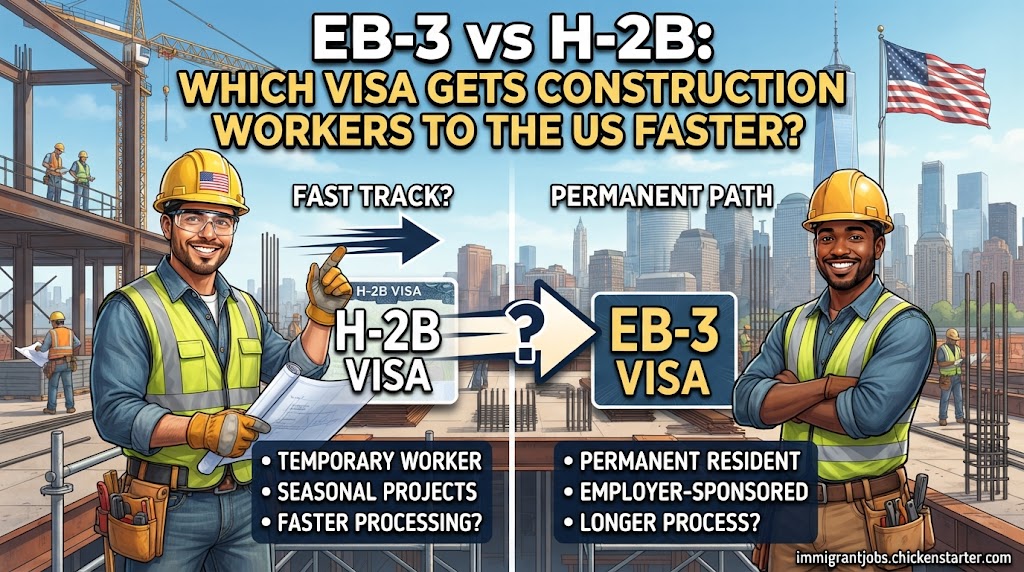
If you are a construction worker weighing your options for getting to the United States, you have probably run into two names over and over: H-2B and EB-3. Both can get a construction worker legally into the US. Both need a real employer behind you. But they are not the same visa, they do not move at the same speed, and picking the wrong one for your situation can cost you years you did not plan to lose.
This guide compares them head to head, using current 2026 numbers, so you can figure out which route actually fits your goals instead of guessing.
Quick Answer: H-2B Is Faster, But It Is Not Permanent
If speed is your only concern, H-2B wins. A clean H-2B case can move from labor certification to a visa in your hand in roughly three to six months. EB-3, on the other hand, is a green card process, and even in a good year it takes several years from start to finish once the labor certification stage and the visa bulletin backlog are added together.
So the real question is not just “which one is faster.” It is “faster to what.” H-2B gets you working in the US quickly, but you have to leave when your authorized time runs out. EB-3 takes much longer, but it ends with permanent residency, not a countdown clock.
What Is the H-2B Visa for Construction Workers
The H-2B visa is a temporary, non-agricultural work visa. Construction is one of the industries that uses it heavily, alongside landscaping, hospitality, and seafood processing. [Insert Internal Link: h-2b visa construction jobs]
How the H-2B process actually works
Your employer starts the process, not you. They have to prove the job is genuinely temporary, meaning it is seasonal, tied to a peak workload, or a one-time project with a clear end date. A general laborer hired for a six-month commercial build fits this description. A permanent, year-round site position does not.
The employer files a labor certification application with the Department of Labor through the ETA-9142B form, runs a recruitment campaign to show no qualified US worker wants the job, and then files Form I-129 with USCIS once labor certification is approved. If you are outside the country, you finish the process with a visa interview at a US consulate.
The 2026 cap situation, and why timing matters more than ever
Here is something a lot of construction workers do not realize until it is too late. H-2B has a hard annual cap, and demand has been blowing past it for years. The statutory limit is 66,000 visas per year, split into two halves of 33,000 each. For fiscal year 2026, the Department of Homeland Security and Department of Labor jointly authorized an additional 64,716 supplemental visas, bringing the total available for the year up to 130,716. Even with that increase, demand has still outpaced supply. USCIS confirmed it had received enough petitions to reach the cap for the second half of FY 2026 by March 10, 2026, and one recent filing period saw over 151,000 worker positions requested for just 33,000 slots.
What this means in practice is that filing early is not optional anymore. Employers who wait until the last minute risk missing the cap entirely and having to wait for the next allocation window, which can push a construction worker’s start date back by months.
How long H-2B actually takes once everything is filed correctly
For a properly filed, cap-available case, the full process from labor certification to a consular interview typically takes three to six months. Once approved, an H-2B worker can stay for the length of the job, and total time on H-2B status across renewals cannot exceed three years. After that, you generally have to leave the US for at least 60 days before you can return on another H-2B.
What Is the EB-3 Visa for Construction Workers
The EB-3 visa is a completely different animal. It is not a temporary work permit. It is an employment-based green card category, meaning the end goal is permanent residency, not a return ticket home. [Insert Internal Link: eb-3 green card for construction workers]
Skilled workers vs Other Workers
EB-3 splits into subcategories. Skilled workers need at least two years of training or experience for the job. Other Workers, sometimes just called EB-3 unskilled, covers roles needing less than two years of experience, which fits a large share of construction jobs like general laborers, framers, and entry-level crew positions. Both subcategories lead to the same result: a green card. [Insert Internal Link: bricklayer jobs in USA with H-2B sponsorship]
The PERM step, and why it slows everything down
Before your employer can file anything with USCIS, they need a PERM labor certification from the Department of Labor. This is a more rigorous version of the recruitment process used for H-2B. The employer has to get a prevailing wage determination, run a documented recruitment campaign following strict rules about timing and ad placement, and prove no qualified US worker applied. PERM processing alone currently runs around 16 months in many cases, and that is before anything gets filed with USCIS.
Once PERM is certified, the employer files Form I-140, the immigrant petition. Processing for that form currently ranges from about 5 to 14 months depending on the service center and whether premium processing is used. Premium processing can get a decision on the I-140 itself in 15 business days for an additional government fee, but as you will see next, speeding up the I-140 does not necessarily speed up your overall wait.
Why the Visa Bulletin controls your real wait time
This is the part that surprises the most people. Even after your I-140 is approved, you do not automatically get a green card. You have to wait for your priority date to become current under the monthly Visa Bulletin published by the US Department of State. Only 10,000 EB-3 Other Worker visas are available worldwide each year, and that number has to cover the worker plus every family member included on the case. A single worker applying with a spouse and three kids uses five of those 10,000 slots by themselves.
For most countries, including Mexico and the Philippines, current data from early 2026 points to a total EB-3 Other Worker timeline of roughly two to four years from PERM filing to visa issuance, though this moves depending on demand each month. For applicants born in China, wait times have generally run in the four to five year range. For applicants born in India, the backlog is dramatically worse, with some estimates running well over a decade due to per-country limits that cap any single country at no more than 7 percent of the total employment-based visas issued each year.
What Documents Your Employer Needs for Each Visa
Understanding the paperwork difference between these two categories explains a lot about why one moves faster than the other.
H-2B documentation
For H-2B, your employer needs proof of the temporary nature of the job, a completed ETA-9142B application, evidence of the recruitment campaign they ran to look for US workers first, and a job order filed with the State Workforce Agency. Once DOL certifies the labor need, they file Form I-129 along with the certified labor condition documents. This is a relatively lean paperwork trail compared to what EB-3 requires, which is one reason the process moves faster.
EB-3 documentation
For EB-3, your employer has to go through the full PERM process, which includes a prevailing wage determination request, multiple mandatory recruitment steps that follow strict federal timing rules, proof of internal posting requirements, and a completed ETA-9089 form. Once PERM is certified, they file Form I-140 with supporting evidence covering your qualifications, the job description, and the employer’s ability to pay the offered wage. Every one of these steps has its own processing queue, which is exactly why the EB-3 timeline stretches out so much longer than H-2B.
Step by Step Timeline: What Actually Happens After Filing
Seeing both timelines laid out side by side makes the speed difference much easier to understand.
H-2B timeline
Step one is the employer’s recruitment effort, run before or during the DOL filing window, to confirm no US worker wants the job. Step two is the ETA-9142B filing with the Department of Labor, which currently moves at a fairly predictable pace outside of peak cap season. Step three is Form I-129 with USCIS once labor certification is approved. Step four, if you are outside the US, is your visa interview at a consulate. Under normal conditions, a worker can go from a signed job offer to arriving in the US in well under six months.
EB-3 timeline
Step one is the prevailing wage determination request, which currently takes a few months to come back from the National Prevailing Wage Center. Step two is the mandatory recruitment period, which by law has to run for a set number of days across specific advertising channels. Step three is the actual PERM filing, which can take around sixteen months to process depending on current DOL workload. Step four is Form I-140 with USCIS, running somewhere between five and fourteen months depending on the service center and whether premium processing is used. Step five is waiting for your priority date to become current under the monthly Visa Bulletin, which is where the real time difference between H-2B and EB-3 shows up. Step six, once your date is current, is either adjustment of status if you are already in the US or consular processing if you are abroad.
Laid out this way, it becomes obvious why EB-3 takes years rather than months. Each step in the chain has its own separate government queue, and none of them can be skipped or combined.
EB-3 vs H-2B: Head to Head Comparison
Speed
H-2B wins by a wide margin if your only goal is getting to work in the US as fast as possible. A clean H-2B case can be done in months. EB-3 is measured in years, sometimes many years, depending on where you were born.
Permanence
EB-3 wins here, no contest. H-2B has a hard three-year ceiling and no built-in path to a green card. EB-3 ends with permanent residency, meaning you and your qualifying family members can live and work in the US indefinitely once approved.
Cost
H-2B is generally cheaper for the employer because it skips PERM entirely and moves through a simpler labor certification process. EB-3 involves more stages, more documentation, and a longer attorney engagement, which usually makes it the more expensive route overall. If you want a full breakdown of what an immigration lawyer charges for either route, this is worth reading closely before your employer commits to either path. [Insert Internal Link: immigration lawyers for construction workers]
Family
Both categories allow spouses and unmarried children under 21 to come along, but the outcome is different. H-2B dependents come on H-4 status and cannot legally work. EB-3 dependents, once the green card is issued, get full work authorization and permanent status alongside the primary applicant.
Risk
H-2B carries cap risk. If your employer files late or demand exceeds supply before your petition is submitted, you may not get a visa number at all for that filing period. EB-3 carries backlog risk instead. Your case can be fully approved and still leave you waiting years simply because of your country of birth and the per-country visa limits built into US immigration law.
How Your Country of Birth Changes the Answer
This is the single biggest factor that changes which visa makes sense, and it gets ignored constantly in generic advice articles.
Mexico, Philippines, and rest of world applicants
If you were not born in India or China, your EB-3 wait time is meaningfully shorter, generally landing in the two to four year range for the Other Workers category as of mid-2026, based on current Visa Bulletin movement. That is still a long wait compared to H-2B, but it is a realistic timeline for someone planning ahead rather than needing to start work immediately.
India and China applicants
If you were born in India, the math changes dramatically. Per-country caps mean Indian applicants in the EB-3 Other Workers category have faced backlogs stretching well over a decade in recent Visa Bulletin data. China faces a shorter but still significant backlog, generally landing in the four to five year range. For workers born in these two countries specifically, H-2B often makes far more practical sense as a near-term option, since the EB-3 route requires a level of patience that most workers simply cannot afford while supporting a family back home.
Real-World Scenarios: Which Workers Should Pick Which Visa
The seasonal project worker
If your job offer is tied to a specific commercial build with a defined end date, or your employer’s need genuinely comes and goes with the seasons, H-2B is the natural fit. You are not trying to relocate permanently. You are trying to work a defined job and go home when it wraps up, possibly returning next season on another H-2B. [Insert Internal Link: h-2b visa construction jobs]
The worker aiming for permanent residency
If your goal is to eventually settle in the US long term, and your employer is willing to commit to the longer PERM process, EB-3 is worth the wait, especially if you were not born in India or China. This path leads somewhere H-2B never can on its own.
The worker who wants both
A growing number of construction workers use H-2B as a starting point while their employer decides whether to invest in a longer-term relationship. Once an employer sees your work ethic and reliability over one or two H-2B seasons, they may be willing to sponsor a PERM case and move you toward EB-3. This combined strategy lets you start earning sooner while keeping the permanent residency door open. [Insert Internal Link: h-2b to eb-3 for construction workers]
Common Mistakes Workers Make Choosing Between EB-3 and H-2B
One frequent mistake is assuming H-2B is a stepping stone to a green card automatically. It is not. The two categories are legally separate, and moving from H-2B to EB-3 requires your employer to start a brand new PERM case from scratch. There is no automatic upgrade.
Another mistake is underestimating how much your country of birth matters. Two workers with identical job offers and identical qualifications can face wildly different EB-3 timelines purely because of where they were born, and this catches people off guard when they only researched the visa category and not the current Visa Bulletin.
A third mistake is waiting too long to start the H-2B filing process. Given how fast the FY 2026 cap filled, some employers who delayed filing lost access to visas for that filing period entirely, pushing worker start dates back by months.
A fourth mistake is choosing a visa category based only on speed without thinking about what happens when the visa runs out. Workers who take H-2B purely because it is faster, without a real plan for what comes next, sometimes find themselves back at square one after three years with no progress toward permanent status. If long-term settlement is genuinely your goal, it pays to have that conversation with your employer early rather than assuming the relationship will naturally evolve into an EB-3 sponsorship later.
A fifth mistake is not accounting for family separation. H-2B dependents cannot legally work in the US, which means a spouse who was earning income back home may have to give that up temporarily with no ability to replace it while accompanying you. This is worth planning around financially before you commit to bringing family along on an H-2B case.
How Employers Decide Between Sponsoring H-2B or EB-3
It helps to understand this decision from the employer’s side too, since their priorities directly shape which visa gets offered to you.
Employers dealing with a genuine seasonal spike, like a large residential development with a hard completion deadline, generally lean toward H-2B because it matches their actual staffing need. Paying for a multi-year PERM process for a job that will not exist in three years makes little business sense from their end.
Employers building a long-term workforce, especially in regions with chronic labor shortages in framing, masonry, or general construction labor, increasingly lean toward EB-3 because retaining a trained, reliable worker for the long haul outweighs the upfront time and cost of the PERM process. Industry data shows construction needs hundreds of thousands of net new workers over the next couple of years just to keep pace with demand, and employers who commit to EB-3 sponsorship are often trying to lock in workforce stability rather than solve a short-term gap.
Some employers use both strategically, starting a worker on H-2B while quietly evaluating whether to invest in a PERM case down the line. If you are negotiating a job offer, it is worth asking directly which category your employer is planning to use and why, since the answer tells you a lot about how they view the relationship long term.
What About UK, Canada, and Australia Construction Workers
While H-2B and EB-3 are specifically US visa categories, the same basic tradeoff exists in other countries that sponsor construction trades.
In the UK, the Skilled Worker visa route is temporary at first but can lead to settlement after five years on the visa, which is a middle ground between the sharp H-2B cutoff and the long EB-3 wait. [Insert Internal Link: bricklayer jobs in UK with visa sponsorship for Nigerians]
In Australia, employer-sponsored trade visas under the Skills in Demand program can also lead toward permanent residency over time, depending on the specific stream and occupation list. [Insert Internal Link: scaffolder jobs in UK and Australia with visa sponsorship]
In both cases, workers face a similar decision to the one in this article: take the faster temporary route now, or commit to a longer process that ends in permanent status. The logic that applies to H-2B versus EB-3 largely carries over, even though the visa names and government agencies are different.
Myths vs Facts
Myth: EB-3 always takes over a decade. Fact: That extreme wait time applies mainly to applicants born in India. Workers from most other countries, including Mexico and the Philippines, are currently looking at a total timeline closer to two to four years for the Other Workers category.
Myth: H-2B automatically converts into a green card if you work long enough. Fact: There is no automatic conversion. Your employer has to start a completely separate PERM and EB-3 process if they want to sponsor you for permanent residency.
Myth: Premium processing fixes the EB-3 wait. Fact: Premium processing only speeds up the I-140 decision itself. It does nothing to change your place in line under the Visa Bulletin, which is usually the actual bottleneck.
Myth: H-2B has no real risk since it is faster. Fact: H-2B carries real cap risk. If your employer files after the annual allocation fills up, which has been happening earlier each year, you may not get a visa number for that period at all.
Myth: Only skilled tradespeople with years of experience qualify for EB-3. Fact: The Other Workers subcategory specifically exists for roles requiring less than two years of experience, which covers a large share of general construction labor positions.
FAQs
Which visa is faster, EB-3 or H-2B? H-2B is faster in almost every case, typically taking three to six months from labor certification to a visa. EB-3 takes years due to the PERM stage and Visa Bulletin backlog.
Can I switch from H-2B to EB-3? Not automatically. Your employer would need to start a brand new PERM labor certification process to sponsor you under EB-3, completely separate from your H-2B case.
Does my country of birth affect EB-3 wait times? Yes, significantly. Workers born in India face the longest backlogs, often exceeding a decade under current Visa Bulletin data. China faces a shorter but still lengthy wait. Most other countries see considerably shorter timelines.
Is H-2B a good option if I eventually want a green card? H-2B alone does not lead to a green card. However, some workers use it to build a track record with an employer who later agrees to sponsor them under EB-3.
How many H-2B visas are available in 2026? The statutory cap is 66,000 per year, but for fiscal year 2026, an additional 64,716 supplemental visas were authorized, bringing the total available to 130,716. Even with the increase, demand has continued to exceed supply throughout the year.
Do I need an immigration lawyer for either visa? Both processes involve strict government deadlines and detailed documentation, so most successful cases go through a licensed immigration attorney rather than being handled informally. [Insert Internal Link: immigration lawyers for construction workers]
What happens if my priority date retrogresses while I am waiting on EB-3? The Visa Bulletin can move backward as well as forward if demand in a category exceeds the annual limit. This is called retrogression, and it can extend your wait even after progress has already been made, which is why tracking the bulletin monthly matters if you are in the middle of the EB-3 process.
Can my spouse work while I am on H-2B status? No. Dependents on H-4 status that come with an H-2B worker are not authorized to work in the US, though they can attend school and travel with you. This is a major practical difference from EB-3, where dependents get full work authorization once the green card is approved.
If I am from India, should I still consider EB-3 for construction work? It depends entirely on your timeline and goals. Given current backlogs that can stretch well over a decade for Indian-born applicants in the Other Workers category, many workers from India find H-2B a more realistic near-term option, while still keeping EB-3 in mind as a longer-term goal if their employer is willing to file a PERM case alongside it.
Final Thoughts
There is no single correct answer to EB-3 versus H-2B. The right choice depends on what you actually need right now. If you need to start earning in the US quickly and your job is genuinely tied to a season or a specific project, H-2B gets you there faster than almost any other legal route available to construction workers. If your goal is permanent residency and you have the patience to wait, especially if you were not born in a country with a heavy backlog, EB-3 leads somewhere H-2B simply cannot take you on its own.
According to the US Department of State’s monthly Visa Bulletin, employment-based categories like EB-3 remain subject to annual per-country limits that directly control how fast a case can move regardless of how strong the underlying petition is, which is exactly why checking current bulletin data before committing to a strategy matters as much as choosing the right visa category in the first place.
If you are still deciding which path fits your situation, take a look at which US employers are actively sponsoring construction roles right now and what each one is offering before you commit to either route. [Insert Internal Link: companies that sponsor green cards for construction workers]