
If you are a construction worker chasing a job offer in the United States, Canada, Australia, or the UK, chances are someone has already told you that you need a lawyer. What nobody tells you is what that lawyer actually does day to day, how much it really costs once every hidden fee is added up, and how to tell a real attorney apart from the agents and “consultants” who prey on tradespeople trying to get sponsored.
This guide breaks all of that down in plain terms. No legal jargon dumped on you without explanation, no vague “it depends” answers without real numbers attached, and no pretending that one lawyer or one visa category fits every construction worker reading this.
Why Construction Workers Need to Understand This Before They Sign Anything
Construction is one of the industries with the deepest labor shortages in the US right now. Industry groups estimate the sector needs hundreds of thousands of new workers just to keep up with current demand, and that gap is exactly why sponsorship programs exist in the first place. Employers are not doing foreign workers a favor. They are solving a real staffing problem, and that gives you more leverage than most workers realize.
The problem is that leverage only helps you if you understand the process well enough to avoid getting taken advantage of. Immigration cases involve real money, real deadlines, and real consequences if something is filed wrong. A missed date on a labor certification recruitment period can push your whole case back by months. A lawyer who does not specialize in employment-based cases can miss details that a specialist would catch immediately. This is why picking the right person to handle your case matters just as much as picking the right visa category.
What an Immigration Lawyer Actually Does for a Construction Worker
A lot of workers picture an immigration lawyer as someone who “fills out forms.” That undersells the job by a lot, and it is one of the reasons people get frustrated when they see the size of the bill.
Before you have a job offer
At this stage, a lawyer usually is not involved yet, and that is normal. This part of the journey is about you finding an employer willing to sponsor you, whether that is a general contractor, a residential builder, a commercial construction firm, or a specialty trade company that needs bricklayers, scaffolders, welders, or general laborers. If you already have leads on companies that sponsor construction workers, that is where your search should start, since sponsorship only becomes possible once a real employer is behind it. [Insert Internal Link: companies that sponsor green cards for construction workers]
Some workers make the mistake of hiring a lawyer before they even have an employer lined up, hoping the lawyer can somehow “find them a job.” A licensed immigration attorney is not a recruiter. Their job starts once there is an actual job offer on the table, so save your money until you have that piece secured.
After your employer agrees to sponsor you
This is where the lawyer’s real work begins. They confirm which visa category actually fits your situation, because a bricklayer heading to a short seasonal project needs a completely different legal strategy than a scaffolder aiming for permanent residency. [Insert Internal Link: bricklayer jobs in USA with H-2B sponsorship]
The lawyer also reviews your employer’s side of the deal. They check whether the company is financially able to support the sponsorship, whether the wage being offered meets the government’s prevailing wage requirement for that job and location, and whether the paperwork trail is strong enough to survive scrutiny from USCIS or the Department of Labor.
Handling paperwork most workers never see
This is where the lawyer earns their fee. That includes the prevailing wage request, recruitment documentation proving no local worker was available for the role, the labor certification filing with the Department of Labor, and the petition filed with USCIS on your behalf. One missed deadline or one weak piece of evidence in that stack can delay your case by months, and in some cases can lead to a denial that costs you the entire filing fee.
A good lawyer also manages communication with USCIS if the agency asks follow-up questions, prepares you for any required interview, and keeps track of every date in your case so nothing slips through the cracks while you are busy working.
The Two Main Paths Construction Workers Use: H-2B and EB-3
Most construction sponsorship cases in the US fall into one of two categories, and mixing them up is one of the most common and costly mistakes workers make.
H-2B: temporary work, renewable but capped
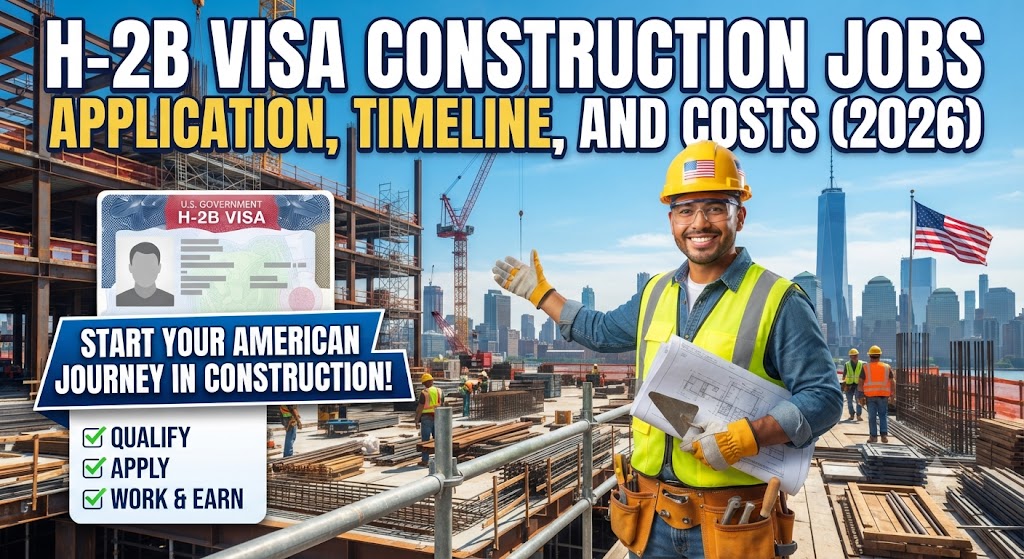
The H-2B visa covers seasonal, peak-load, or one-time non-agricultural work, and construction is one of the industries that regularly uses it. Your employer has to prove there is a genuine seasonal or temporary need, get a temporary labor certification from the Department of Labor, then file Form I-129 with USCIS on your behalf. It typically takes a couple of months to process once everything is filed correctly, and current rules cap total time on H-2B status at three years. It does not lead to a green card on its own, and you are expected to return home once your authorized period ends. [Insert Internal Link: h-2b visa construction jobs]
H-2B makes the most sense if the job itself is genuinely tied to a season or a specific project, such as a large commercial build with a defined end date, or landscaping and outdoor construction work that naturally slows down in colder months.
EB-3 Other Workers: the green card route
The EB-3 “Other Workers” category is built for jobs that require less than two years of training or experience, which covers a large share of entry-level and mid-level construction roles like general laborers, framers, and helpers on a crew. This is a permanent pathway, not a temporary one. Your employer must secure a PERM labor certification, proving again that no qualified local worker was available and that hiring you will not undercut local wages or working conditions. After that, they file Form I-140. If approved, you are in line for a green card, though wait times for this category can run several years depending on your country of origin, since annual visa numbers are limited and demand is high. [Insert Internal Link: eb-3 green card for construction workers]
Which one fits your situation
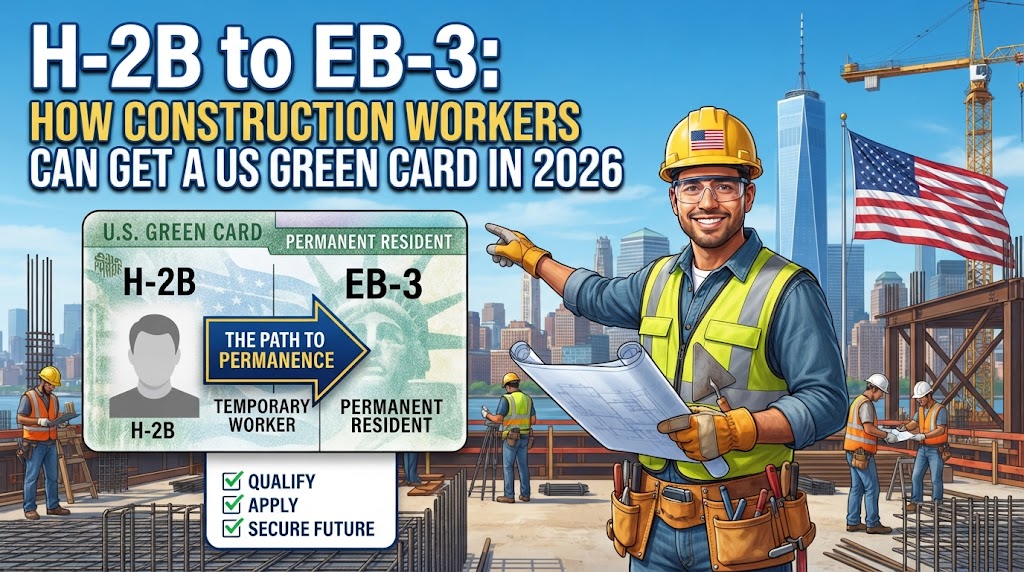
If your job is genuinely temporary or seasonal, H-2B is usually the right call and moves faster. If your goal is permanent residency and your employer is willing to commit to the longer PERM process, EB-3 is worth the wait. Some workers use H-2B first while their employer evaluates them, then transition toward EB-3 sponsorship once the company sees the long-term value of keeping them on. [Insert Internal Link: h-2b to eb-3 for construction workers]
A Simple Comparison
H-2B is temporary, capped at three years total, faster to process, and does not lead directly to permanent residency.
EB-3 Other Workers is permanent, takes considerably longer because of the PERM labor certification stage, and leads directly toward a green card if the case is approved and a visa number becomes available.
Neither one is automatically “better.” The right choice depends entirely on whether you and your employer are aiming for a short-term arrangement or a long-term relationship.
How Much Does an Immigration Lawyer Cost for Construction Workers
This is the part most sites dance around. Here are realistic numbers based on current market rates for 2026, broken down so you can actually budget around them instead of guessing.
Flat fee vs hourly billing
Most immigration lawyers charge a flat fee for standard work visa and green card petitions, because the process follows a fairly predictable set of steps once the category is chosen. Hourly billing, usually somewhere between 150 and 550 dollars an hour, tends to show up only for complicated cases, past denials, prior immigration violations, or anything involving immigration court. For a straightforward construction sponsorship case, you should expect a flat fee quote, not an open-ended hourly bill.
Typical price ranges by visa type
For an H-2B petition, attorney fees generally land somewhere between 1,500 and 5,000 dollars, separate from government filing fees. Simpler cases involving a returning worker with a clean history usually sit toward the lower end of that range, while first-time petitions or larger group filings can push toward the higher end.
For an EB-3 case, which involves the longer PERM process plus the I-140 petition, total attorney fees often run from around 2,000 dollars on the low end up toward 10,000 dollars or more for firms handling complex recruitment documentation across multiple positions. Because EB-3 involves more steps and a longer paper trail, it is naturally more expensive than H-2B, and any quote that seems dramatically cheaper than this range deserves extra scrutiny.
Initial consultations, where a lawyer reviews your situation before you commit to anything, usually cost between 100 and 400 dollars, and some firms offer this part for free as a way to earn your business before asking for payment.
Government filing fees are separate
Whatever the attorney charges is on top of what the government charges, and this is where a lot of workers get confused about the total cost of their case. Form I-140 alone currently carries a filing fee of around 715 dollars, and if premium processing is used to speed up the adjudication timeline, that adds close to 2,965 dollars more on top. These government fees change from time to time as agencies adjust their fee schedules, so always confirm the current amount directly through USCIS before paying anything or budgeting your total case cost.
Who usually pays: you or your employer
For employment-based sponsorship like H-2B and EB-3, the employer is generally expected to cover the labor certification and petition-related costs, since federal rules restrict shifting certain specific costs onto the worker, particularly under H-2B. In practice, arrangements still vary by employer and by country, so get this in writing before you agree to anything. A written engagement letter or offer letter that spells out exactly who pays for what protects both sides if a disagreement comes up later. [Insert Internal Link: scaffolder jobs in UK and Australia with visa sponsorship]
Hidden Costs Nobody Tells You About
Beyond the base attorney fee, a handful of extra costs tend to catch workers off guard partway through the process.
If USCIS issues a Request for Evidence asking for more documentation, some firms charge an additional 1,000 to 5,000 dollars to respond, though a growing number of firms now build one RFE response into the original flat fee as a standard part of their service. Ask about this specifically before signing anything.
Certified translations of foreign documents, such as birth certificates, marriage certificates, or trade certifications, typically run 50 to 150 dollars per page depending on the language and the translation service used.
A required medical exam with a USCIS-approved civil surgeon usually costs between 200 and 500 dollars, and this is a separate appointment from anything your lawyer handles directly.
If your case gets denied and needs refiling, some firms charge the full fee a second time, while others offer a reduced rate for the second attempt. Ask about this scenario upfront, even if you feel confident your case is strong, because it is much easier to negotiate this term before there is a problem than after one shows up.
Immigration Lawyers for Construction Workers Outside the US
Since sponsorship demand for construction trades is not limited to the United States, it helps to understand how the lawyer’s role shifts slightly depending on the country.
United Kingdom
In the UK, construction sponsorship generally runs through the Skilled Worker visa route, and the employer must hold a valid sponsor licence issued by the Home Office before they can sponsor anyone at all. An immigration lawyer or an OISC-registered adviser typically checks whether the job and salary meet the minimum requirements for the route, helps the employer issue a Certificate of Sponsorship, and manages the visa application itself. Fees for UK immigration advisers vary widely, but workers should always confirm that whoever they are dealing with is properly registered, since operating as an unregistered immigration adviser is illegal in the UK. [Insert Internal Link: bricklayer jobs in UK with visa sponsorship for Nigerians]
Australia
Australia’s main employer-sponsored pathway for trades runs through the Skills in Demand visa program, which replaced the older Temporary Skill Shortage visa. A registered migration agent or immigration lawyer checks whether your trade occupation appears on the relevant skilled occupation list, confirms your qualifications meet the required standard, and manages the nomination and visa stages with the employer. Trade roles like scaffolding, bricklaying, and carpentry regularly appear on these lists because of ongoing labor shortages in the construction sector. [Insert Internal Link: scaffolder jobs in UK and Australia with visa sponsorship]
Canada
In Canada, construction sponsorship commonly runs through the Temporary Foreign Worker Program, which usually requires the employer to first obtain a Labour Market Impact Assessment, known as an LMIA, proving no Canadian worker was available for the role. An immigration lawyer or a Regulated Canadian Immigration Consultant helps the employer through the LMIA process, then manages the work permit application itself. Some construction workers eventually use their Canadian work experience to qualify for permanent residency programs later on.
Across all four countries, the same core principle applies. The lawyer’s job is to make sure the employer’s side of the paperwork is airtight, because a weak employer application can sink an otherwise qualified worker’s case regardless of how skilled that worker actually is.
How to Avoid Notario Fraud and Fake Visa Agents
This is where a lot of construction workers lose money they cannot afford to lose, and it deserves its own section because the risk is real and it targets tradespeople specifically.
In the United States, a “notario” is not a licensed attorney, no matter what the word sounds like or what the office looks like. In Spanish-speaking countries, “notario publico” refers to a highly trained legal professional, but in the US the term has no equivalent legal weight, and people who use the title to sound official are often not licensed to practice immigration law at all.
Genuine immigration attorneys are licensed to practice law and can be verified through your state’s bar association website in a matter of minutes. Genuine migration agents in Australia are registered with the Office of the Migration Agents Registration Authority. Genuine immigration advisers in the UK are registered with the Office of the Immigration Services Commissioner. There is no excuse for skipping this check, because it takes less time than reading this paragraph.
Red flags include anyone guaranteeing a visa approval, since no licensed professional can honestly promise a government agency’s decision in advance. Watch for anyone asking for full payment in cash with no written contract, anyone offering a “fast track” green card for a flat cash sum outside the normal PERM process, and anyone who cannot explain in plain language what stage your case is at right now. If a fee sounds too low for the amount of legal work involved, that is usually because there is no real legal work happening at all, and you may end up with a stack of forms that were never properly filed. [Insert Internal Link: bricklayer jobs in UK with visa sponsorship for Nigerians]
What Happens After You Hire a Lawyer: A Realistic Timeline
Once you sign on with a legitimate immigration lawyer, the process generally follows this order, though exact timing shifts depending on government processing volume at any given moment.
Step one is an eligibility review, where the lawyer confirms which visa category fits your job and background, and flags anything in your history that could complicate the case early rather than letting it surface later.
Step two, for EB-3 cases specifically, is when your employer requests a prevailing wage determination from the Department of Labor, confirming the minimum wage that must legally be offered for your specific job and location. This stage currently takes a few months to come back.
Step three is mandatory recruitment, where the employer advertises the position through approved channels to confirm no qualified local worker wants the job. This recruitment period has to follow strict rules about how long the ads run and where they appear, and any shortcut here can jeopardize the whole case.
Step four is filing the labor certification once recruitment closes clean, followed by a waiting period while the Department of Labor reviews the file.
Step five, once labor certification is approved, is when your lawyer files the actual visa petition. From there you are either waiting on visa number availability through the Visa Bulletin for EB-3 cases, or moving fairly quickly toward approval for H-2B cases.
Each stage has its own waiting period, and PERM labor certification alone can take anywhere from six months to over a year depending on current government processing volume, so patience is genuinely part of the process rather than a sign that something has gone wrong.
Questions to Ask Before You Pay an Immigration Lawyer
Before you hand over any money, ask exactly what the flat fee covers and what triggers an extra charge on top of it. Ask whether an RFE response is included in that fee or billed separately. Ask who is responsible for government filing fees, you or your employer, and get that answer in writing. Ask how they will communicate updates to you, since a lawyer who goes silent for months at a time creates unnecessary stress during an already anxious process. Ask for a written engagement letter that spells out the full scope of work before you sign anything or send any payment.
A lawyer who avoids giving you straight answers to these questions is not someone you want handling a case this important, no matter how confident they sound in a phone call.
Common Mistakes Construction Workers Make When Hiring a Lawyer
One common mistake is choosing a lawyer based purely on price without checking whether they actually specialize in employment-based sponsorship, since a general practice attorney who mostly handles family petitions may not be as sharp on the specific rules that apply to PERM and labor certification.
Another mistake is not confirming the employer’s role in the agreement upfront, which sometimes leads to disputes later about who was supposed to pay for what.
A third mistake is going quiet on communication and assuming “no news is good news,” when in reality staying in regular contact with your lawyer helps you catch small issues before they become expensive delays.
Myths vs Facts About Immigration Lawyers for Construction Workers
Myth: Any lawyer can guarantee your visa gets approved. Fact: No licensed attorney can guarantee a government approval, and anyone who promises this is a warning sign worth walking away from.
Myth: You always have to pay for everything yourself. Fact: Employers are typically expected to cover labor certification and petition costs for employment-based sponsorship categories like H-2B and EB-3.
Myth: EB-3 is only for skilled tradespeople with years of experience. Fact: The “Other Workers” subcategory specifically covers roles needing less than two years of experience, which fits a large share of construction jobs including general labor positions.
Myth: A cheaper lawyer always means a bad lawyer, and an expensive one always means a good one. Fact: Pricing varies by city, firm size, and case complexity, but the real test is whether the fee structure is written down clearly, not just how high or low the number happens to be.
Myth: Once your labor certification is approved, the hardest part is over. Fact: Labor certification approval is a major milestone, but visa number availability under the Visa Bulletin can still add years to the timeline for EB-3 cases from high-demand countries.
FAQs
Do I need a lawyer for an H-2B visa?
It is not always legally required, but the process involves strict deadlines and detailed labor market documentation, so most successful cases go through a licensed attorney who specializes in this visa category.
Can my employer pay for my immigration lawyer?
Yes, and for employment-based sponsorship categories, employers are generally expected to cover labor certification and petition-related costs as part of the sponsorship arrangement.
How long does the EB-3 process take from start to finish?
Between PERM labor certification, I-140 processing, and visa number availability, the full timeline commonly runs from about two years up to several years depending on your country of origin and current visa demand.
What is the difference between H-2B and EB-3 for construction workers?
H-2B is temporary and capped at three years total with no path to a green card built into the category itself. EB-3 is a permanent pathway that leads directly to a green card, but takes considerably longer because of the labor certification requirement.
How do I check if an immigration lawyer is really licensed?
In the US, search their name through the state bar association where they claim to practice. In the UK, check the OISC register. In Australia, check the MARA register. A legitimate professional will have an active, verifiable record.
Can I switch lawyers if I am not happy with mine?
Yes, though switching mid-case can sometimes cause short delays while the new lawyer reviews the existing file, so it is worth trying to resolve communication issues directly first if possible.
Do I need a different lawyer for my spouse and children’s applications?
Usually not. Spouses and unmarried children under 21 are typically included as derivative beneficiaries on the same case, handled by the same lawyer, once the primary applicant’s petition is approved.
Final Thoughts
Getting sponsored as a construction worker is a real, well-used pathway, not something reserved for office jobs or highly credentialed professionals. The workers who come out of the process without losing money or time are the ones who understood the real costs upfront, picked the right visa category for their actual situation, and worked with someone properly licensed to handle it from start to finish.
According to guidance published by USCIS, employment-based petitions like the EB-3 require employer sponsorship and a certified labor certification before a petition can even be filed, which is exactly why the employer relationship matters as much as the lawyer you choose. Getting both pieces right from the beginning is what separates a smooth sponsorship case from one that drags on for years longer than it needed to.
If you are still comparing your options, take a look at what companies are currently sponsoring construction roles and which visa category matches your experience level before you spend a dollar on legal fees. [Insert Internal Link: h-2b visa construction jobs]


I am Harrison I live in Nigeria I am interesting of the construction work because skills is my field welding apartment